
Do you find yourself wondering if there is something wrong with you? Or maybe you're wondering why you don't seem to need people like everyone else does? At Phoenix Rebellion Therapy, we receive versions of this question frequently from individuals who are successful, capable, and caring, yet experience an unsettling sense of entrapment in their relationships when others seek to access their emotions.
You may relate to these examples if you tend to do everything yourself; if you become suffocated when a partner requests reassurance; if you appear calm on the outside, yet "go numb" on the inside during conflicts; or if others describe you as "hard to read." On the surface, you may project confidence and independence. However, on the inside, you may feel safer keeping people at arm's length.
Each of these behaviors may indicate a dismissive avoidant attachment style.
At Phoenix Rebellion Therapy, with locations in Murray and Kaysville, Utah, and virtual therapy options throughout the state, our team of specialists includes therapists trained in Trauma and Attachment (Brett, Juliann, Kim M., and Jessica H.). Our team utilizes EMDR and A.R.T. for childhood origins combined with EFT, CBT and traditional talk therapy to assist you in creating a more secure pattern of behavior in the present.
This article is a follow-up to our previous blog post regarding anxious-preoccupied attachment. If you recognize an anxious–avoidant push-pull dynamic within your relationships, this article may be particularly relevant.
What Is Dismissive Avoidant Attachment?
Dismissing Avoidant Attachment is a behavioral pattern wherein emotional self-sufficiency is utilized primarily to ensure safety. Many people exhibiting this pattern developed in environments where their emotional expressions were either dismissed, suppressed or ridiculed. Studies related to attachment suggest approximately 20–25 percent of adults fall into some form of avoidant classification. Therefore, you are not alone in experiencing this pattern.
Although you may appear independent and nonchalant (or "low-drama") to others, internally, you may feel overwhelmed by the emotional demands placed upon you. You may be uncertain as to how to rely on others, or even embarrassed to require assistance in general.
For many of our Utah clients, this pattern began early. If you experienced messages similar to "stop crying," "do not be so sensitive," or "you are fine," your nervous system may have internalized a very specific rule:
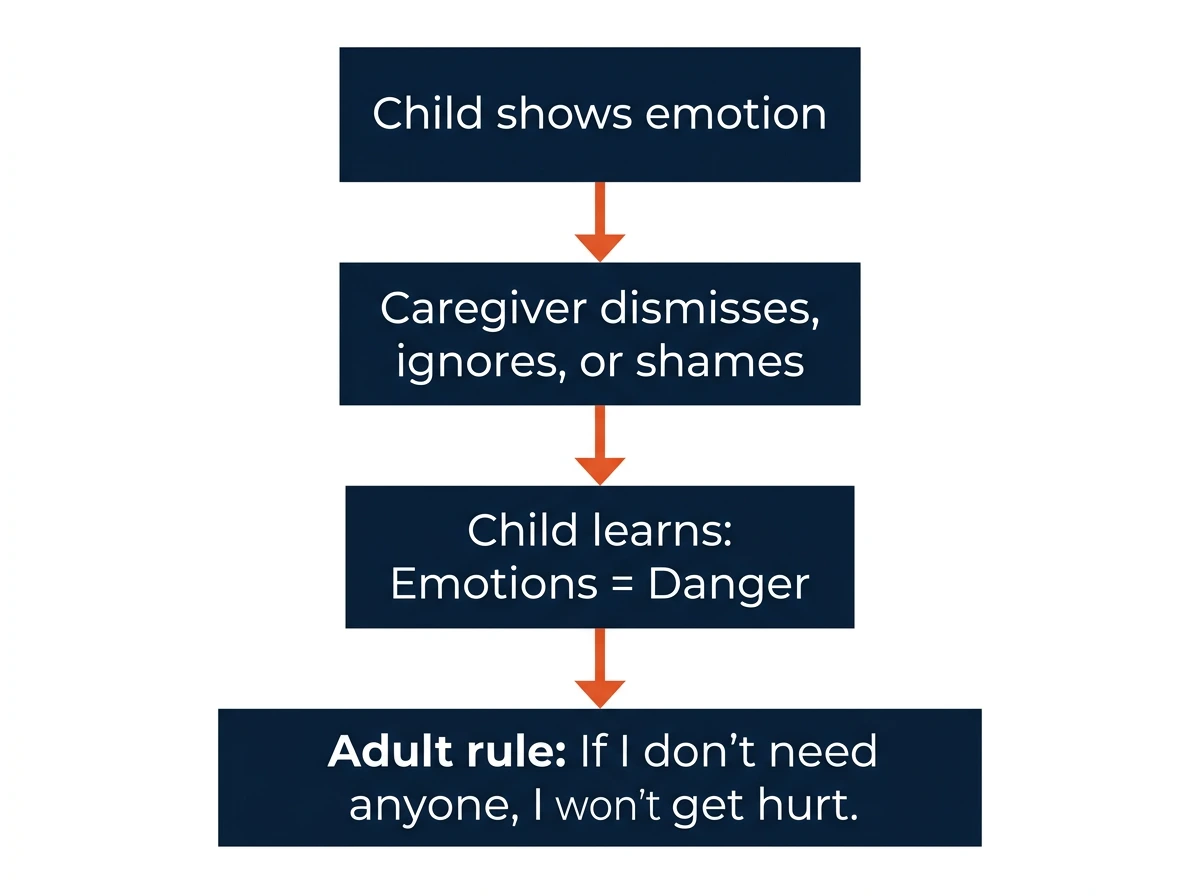
Eventually, this protective mechanism may evolve into negative beliefs such as "my emotions are a problem," "being vulnerable is a weakness," or "I am better off on my own." Although these beliefs may have assisted you in navigating childhood, they may now be creating confusion, isolation and emotional distance in adult relationships.
What Dismissive Avoidant Attachment Can Look Like In Real Life
You do not have to hit every sign on a checklist to relate. Often people notice a handful of familiar patterns across their life.
Pride in Being "Low Need"
Many dismissive avoidant clients describe themselves as easy, low maintenance, or "no trouble." You may rarely ask for help, even when overwhelmed. You might feel a quiet sense of pride that you can handle everything yourself. One client in our Murray office once said:
On the surface it looks strong. Underneath, it is often a fear that if you show needs, you will be rejected, shamed, or let down.
Shutting Down During Conflict
Instead of yelling or chasing, you might go flat. Your partner may be crying or raising their voice while you feel yourself go blank. You start thinking about work, your to-do list, or anything else to escape the emotional intensity. From the outside, you might look like you do not care. In reality, your nervous system is overwhelmed and protecting you by going numb.
Partners often experience this as coldness or stonewalling. Research on couples has shown that physiological arousal can spike during conflict even when one person looks calm. Inside, your heart rate may be up, your body might feel tight, and you feel a strong urge to shut down or leave.
Avoiding "Heavy" Emotional Conversations
You might be great at talking about ideas, plans, or logistics but feel impatient when conversations turn emotional. When someone wants to talk about their fears or insecurities, you may change the subject, crack a joke, or respond with logic instead of empathy. It can feel like emotions are messy and unproductive.
Your partner says, "I felt really alone last night when you were on your phone." Instead of saying, "I hear you, and that matters to me," you might respond with, "I was just tired," or, "We were in the same room, what is the problem?" The emotional signal gets lost.
Feeling Trapped When People Get Close
Early in a relationship, you may feel excited and secure. However, as your partner desires greater closeness and openness, your internal response may shift. You may find yourself receiving constant texts from your partner, feeling pressured to engage in discussions about sensitive topics, and/or having fantasies of escaping.
Many of our Utah clients report that this represents a "switch" being flipped. One week, they may be completely smitten with their partner. The next week, they may be searching for reasons to establish physical and emotional distance. This is not typically due to the actions of their partner. Rather, it is because the couple's intimacy has reached the maximum threshold of what their nervous system is currently prepared to endure.
The Anxious–Avoidant Push–Pull Pattern
If you identify as more avoidant, you may recognize that you commonly pair with anxious partners. According to attachment researchers, this combination is extremely prevalent.
Below is an illustration of how this pattern plays out in real-life scenarios:
When an anxious partner requires reassurance and interaction, they typically become more aggressive in their pursuit. They may text repeatedly, ask multiple questions, and encourage "talking it through" when they feel disconnected.
Conversely, a dismissive avoidant partner requires separation and silence to regulate their emotional response. When they perceive excessive pressure, they will withdraw, go silent, and/or redirect their attention to other priorities.
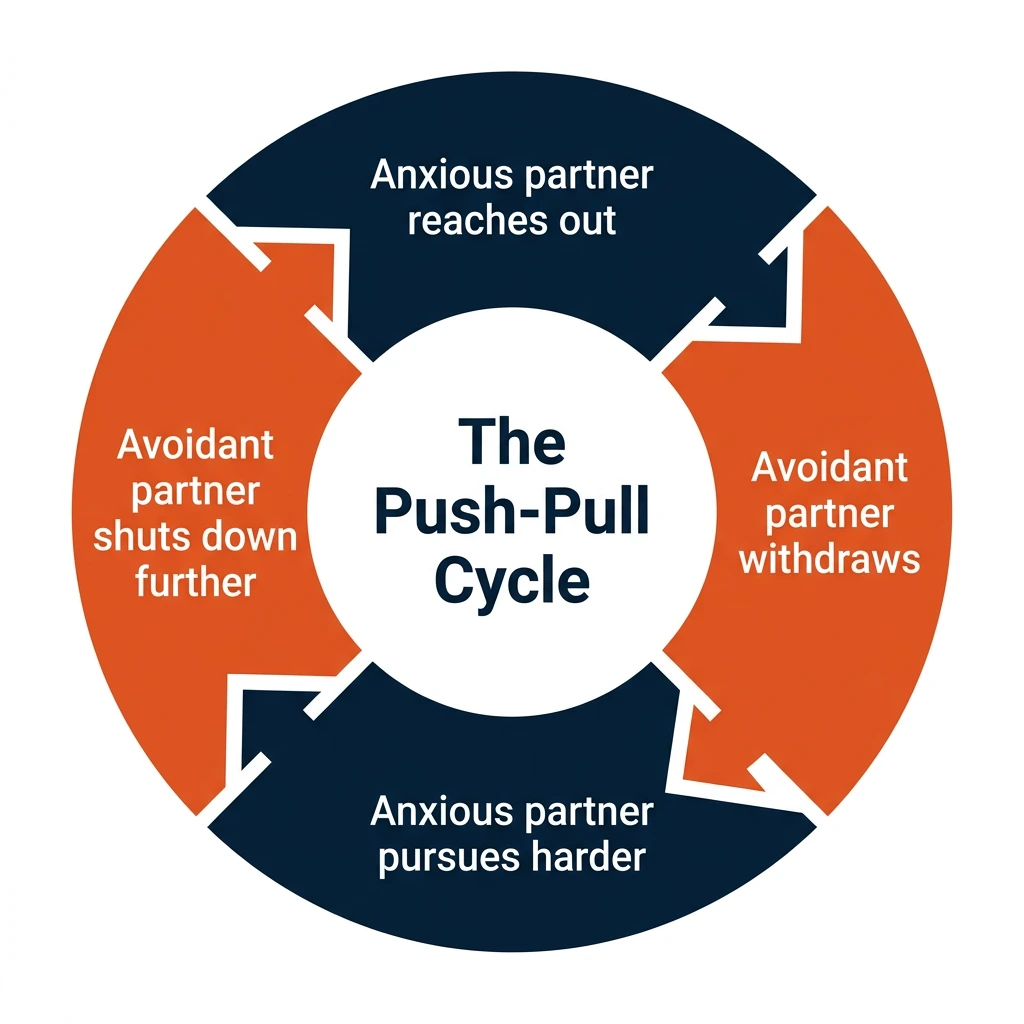
Your partner in Kaysville sends you a message stating, "You have been very quiet this past week. Are we okay?" You experience an immediate surge of anxiety. To alleviate this anxiety, you delay responding to the message or provide minimal responses. Your partner recognizes your withdrawal and subsequently increases their anxiety. They may send lengthy messages asking for clarification, stating things such as, "Please just let me know what is occurring." You continue to experience increased anxiety and ultimately withdraw further.
This pattern produces a cycle of fear and isolation:
- The anxious partner reaches towards you.
- You shield yourself from their reach by withdrawing.
- Both you and your partner eventually feel isolated.
In our couples' therapy in Murray and Kaysville, and via virtual therapy throughout Utah, we assist individuals in slowing this cycle and developing a new pattern of behavior that allows both parties to safely explore a range of distances and closeness.
Recognize This Pattern in Your Relationship?
Our therapists specialize in attachment-based work for individuals and couples throughout Utah.
Schedule an AppointmentWhere Dismissive Avoidant Attachment Often Comes From
Everyone's story is different, but there are common themes we see again and again in clients with avoidant patterns.
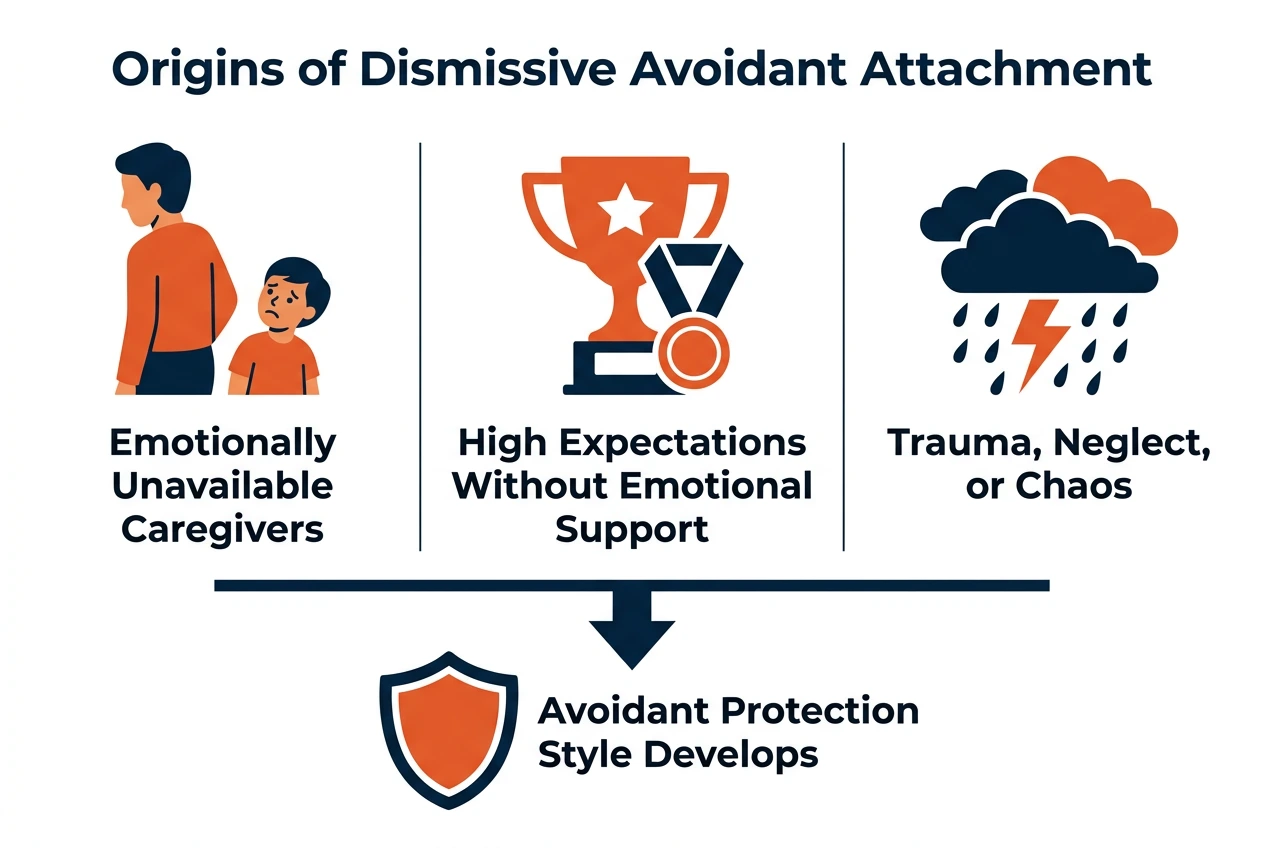
Emotionally Unavailable or Dismissing Caregivers
Maybe your caregivers were there physically, but not emotionally. You might have been clothed, fed, and taken to activities, but when you were sad or scared, you heard, "You are fine," or, "Stop crying." You may have learned that emotional expression leads to eye rolls, criticism, or boredom.
Attachment studies have found that when caregivers consistently ignore or shut down children's bids for comfort, those children often grow into adults with more avoidant styles. It is not because they did anything wrong. It is because they adapted to the environment they were in.
High Expectations Without Emotional Support
Some of our Utah clients grew up in high-achievement or high-demand homes. Grades, sports, chores, or church expectations were front and center. Emotions were not. You might have been praised for being tough, competent, or "the kid who never causes problems."
Over time, it can feel easier to excel, perform, and please, rather than to feel.
Trauma, Neglect, or Chaos
If there was trauma or chaos at home, emotional expression may have felt dangerous. You may have watched adults explode in anger or collapse under stress. You may have felt responsible for keeping the peace.
With EMDR and A.R.T., our trauma therapists often help clients uncover memories like sitting in their room quietly while their parents fought in the next room, or hiding their tears during a big move or divorce. These experiences silently teach children, "If I do not show my feelings, I might stay safe."
Those lessons do not just disappear when you become an adult. They live in the body until they are processed.
How Dismissive Avoidant Patterns Show Up Across Life
This pattern usually does not only affect romance. It shapes friendships, work, and your inner world.
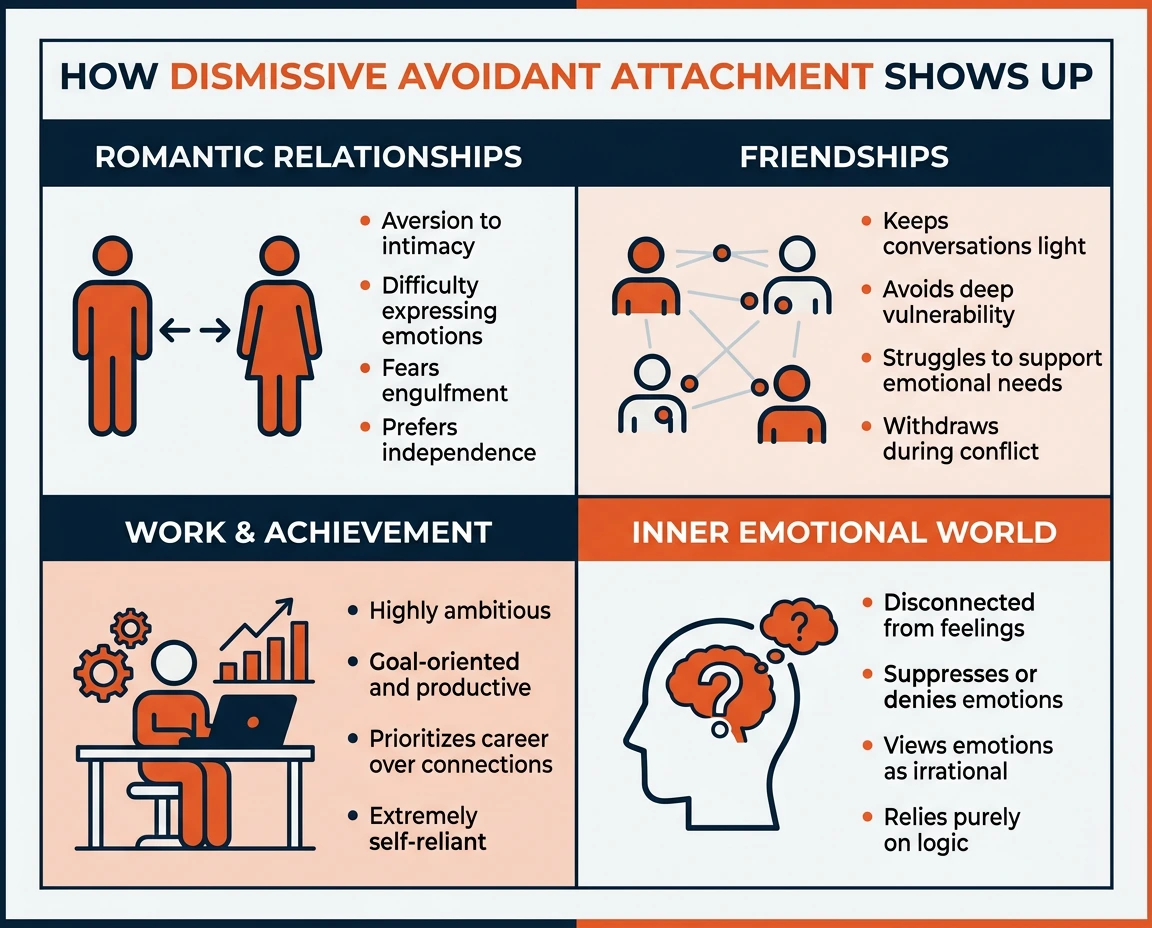
Romantic Relationships
You might genuinely care about your partner but struggle to show it in the ways they need. You may forget to text back, avoid deeper conversations, or feel critical when they ask for more. You might leave relationships when they get too serious or end them by cutting off quickly instead of working through conflict.
Friendships
You may keep a lot of relationships at a "surface" level. You are friendly and helpful, but you do not often share your personal struggles. When a friend is going through something intense, you might feel unsure how to show up. It can feel safer to offer a solution than to sit with their pain.
Work and Achievement
Many avoidant clients are high achievers. Work feels predictable. Relationships do not. You might throw yourself into your job, schooling, or projects because there is clear feedback and reward. You might be viewed as responsible and independent, yet colleagues notice you avoid vulnerable conversations or prefer to handle everything yourself.
Inner Emotional World
Inside, you may feel disconnected from your own feelings. You might know you are "off" but struggle to name if you are sad, angry, or afraid. When big feelings do surface, they can be startling, like a wave you did not see coming. A part of you might quietly long for deeper connection, while another part insists you are better off alone.
Can Dismissive Avoidant Attachment Change?
Yes. Attachment patterns represent habits, not destiny.
At Phoenix Rebellion Therapy, we inform our clients that, "You adopted this style of attachment for a good reason. Your nervous system was attempting to safeguard you. We now have the opportunity to determine collectively which components of this style are beneficial and which elements are detrimental."
Recovery does not imply that you will become clingy or lose your capacity for independence. Recovery implies that you will be capable of:
- Staying connected to your emotions while connecting to other people.
- Requesting what you require without experiencing shame or vulnerability.
- Permitting trusted individuals to witness more of your internal world at a speed that is acceptable to you.
There is substantial research demonstrating that through consistent, nurturing relationships and targeted trauma work, individuals can transition toward a more secure attachment. This can occur in individual therapy, couples' therapy, and close friendships.
How We Work With Dismissive Avoidant Attachment in Therapy
Our therapists in Murray and Kaysville, as well as across Utah via online sessions, specialize in trauma and attachment-focused work.
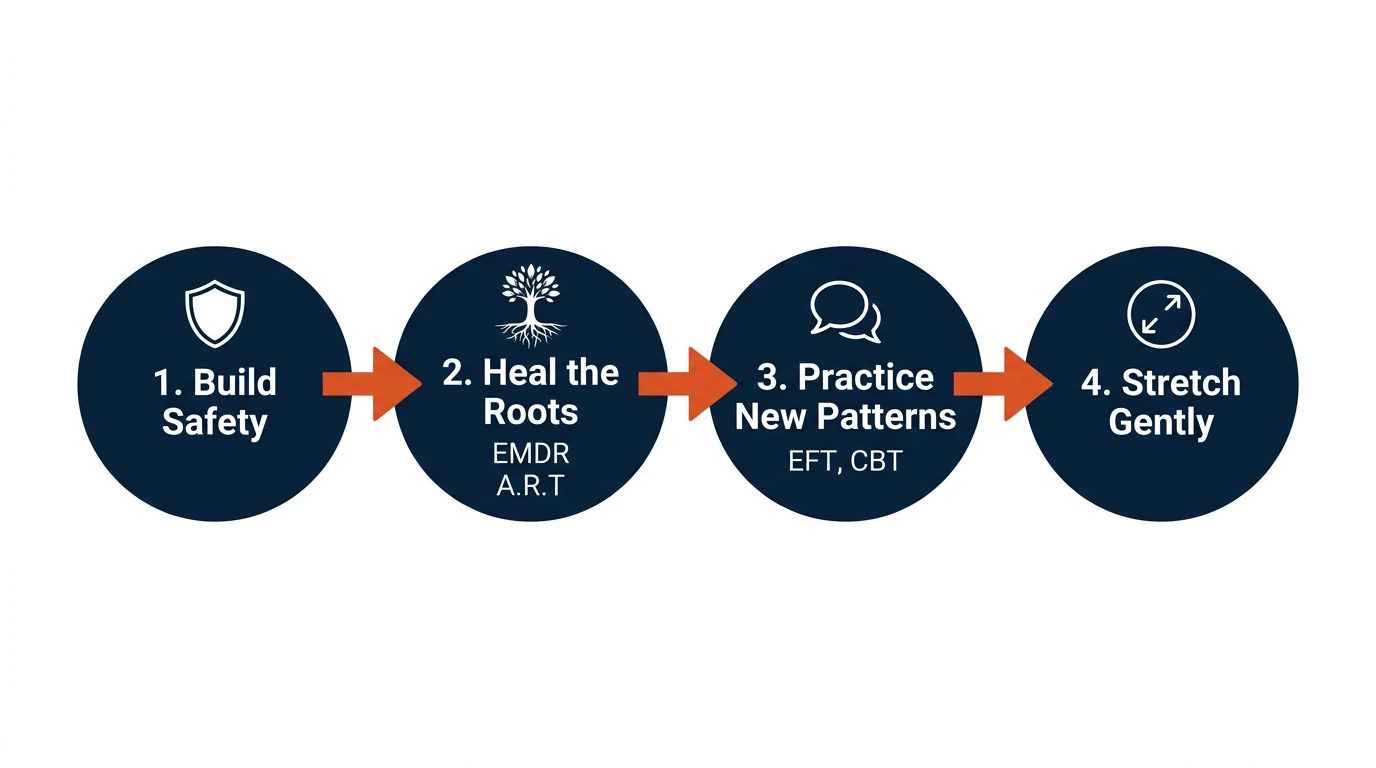
Building Safety First
We move at your pace. We will not push you to open up faster than you are ready. In the beginning, you might be more comfortable talking about your history, your job, or your routines. That is okay. We respect the protective parts of you that have kept you safe for years.
Therapists like Brett, Juliann, Kim M., and Jessica H. are trained to notice when you begin to shut down, and to help you slow that moment down, rather than push through it. Therapy becomes a place where you can experiment with being a little more present, without feeling attacked or judged.
Healing the Roots With EMDR and A.R.T.
Once there is enough safety, we often use EMDR or A.R.T. to process the memories and experiences that shaped your avoidant style. For example, we might focus on a time when you were crying in your room and no one came, or when you tried to share a fear and were mocked.
These therapies help your brain and body file those experiences away in a more adaptive way, so they no longer run the show in the present. Many clients report that, after this work, emotional closeness feels a bit less dangerous. They notice they can stay in hard conversations slightly longer, or that their partner's needs do not immediately feel like criticism.
Practicing New Patterns With EFT, CBT, and Talk Therapy
With EFT, CBT, and talk therapy, we help you build new skills on top of that deeper trauma work. In session, that might mean:
- Learning how to name what you feel in simple language.
- Noticing early body cues that you are about to shut down, like tightness in your chest or wanting to look at your phone.
- Practicing saying small, honest sentences such as, "I care about you, and I also feel overwhelmed right now."
In couples sessions, we help your partner see that your withdrawal is often fear or overload, not a lack of love. We also support you in taking small emotional risks, like sharing more of what is happening inside before you detach.
Gentle First Steps If You Relate To This
You do not have to fix everything at once. Small, consistent steps matter.
Start by Noticing
Begin by simply observing your patterns. When do you want to pull away. When do you feel numb. When do you roll your eyes internally at "drama." You might jot quick notes in your phone about these moments. The goal at this stage is awareness, not change.
Trade Judgment for Curiosity
Instead of asking, "What is wrong with me," try, "What is this part of me trying to protect." Another question that can help is, "When did I first learn that showing need was dangerous or pointless."
Practice a Small Stretch
You do not need to become emotionally wide open overnight. Pick one relationship that feels relatively safe. Then, once a week, try a small experiment such as:
- Sharing one extra sentence about how you feel.
- Staying in a slightly uncomfortable conversation for two more minutes.
- Saying, "I do not know how to talk about this, but I am trying."
We often call this "stretching, not flooding." You are gently training your nervous system to tolerate a bit more connection without shutting down.
Consider Working With a Trauma and Attachment Specialist
If you live in Utah and this feels familiar, you do not have to figure it out alone. At Phoenix Rebellion Therapy, we specialize in:
- Trauma and PTSD, using EMDR and A.R.T.
- Attachment-based work, especially anxious and avoidant patterns.
- Relationships and couples, including anxious–avoidant dynamics.
- Anxiety and nervous system regulation.
We know these patterns were built for a reason. We respect that, and we walk with you as you build something new.
You Are Not "Too Independent" To Heal
If you've spent years telling yourself you don't really need people, opening yourself to the possibility that some part of you is craving a deeper connection could be scary. Healing a dismissive-avoidant attachment pattern will allow you to be independent and have close relationships at the same time.
What that might look like is:
- Being able to let your independence and reliance upon yourself be a strength - and at the same time be willing to rely on others when you need to.
- Giving yourself permission to accept the kind of care you may never have received as a child.
- Understanding that having closeness can be a choice and can feel safe (not just something you survive or run from).
We would love the opportunity to help you work with a therapist who understands trauma and attachment if you are willing to take the first step.
We offer in-person sessions at both our Murray and Kaysville office locations, as well as virtual sessions over secure video conferencing from anywhere in Utah.
You are not too old; you are not too stuck; you are not too independent to change. Your attachment style is a reflection of how you survived. The right support can make it the foundation for your healing.
Ready to Start Your Healing Journey?
Our therapists specialize in trauma and attachment work. Take the first step toward more secure, fulfilling relationships.
Schedule an Appointment