
We hear things like this a lot:
If any of that sounds familiar, you might be running into something a lot of adults carry: old wounds from childhood that never really got tended to. In therapy, we call this inner child work.
It sounds a little abstract at first. But once we explain what it actually means, most people look at us and say, "Oh. That is exactly what this is."
Here is what inner child work is, what it looks like in real life, and how we help you do it in a way that feels safe, not overwhelming.
What Is the Inner Child?
Your inner child is not a metaphor for being immature. It is a real part of your psychology. It formed during your earliest years, when your brain was still developing and you depended entirely on the adults around you to feel safe, loved, and seen.
During those years, you were taking in everything. Not just facts, but conclusions about yourself and the world:
- Am I lovable? Or do I have to earn it?
- Is it safe to say how I actually feel?
- Will the people I need most stay, or leave?
- Is it okay to have needs at all?
Those conclusions got wired in early. And the child who drew them is still inside you. When something in your adult life echoes those early experiences, a tone of voice, a moment of rejection, being ignored by someone you care about, that part of you can get activated instantly.
It does not matter that you are 35 or 50, or that you know better on paper. When that younger part of you gets triggered, the reaction comes first. The rational thinking catches up later.
Inner child work is the process of going back to those early experiences, carefully and at your own pace, to understand what that younger version of you needed, what they never got, and how those unmet needs are still shaping your life today.
Juliann, one of our licensed clinical social workers with over 25 years of trauma experience, puts it this way: "Inner child work is not about becoming childish. It is about getting honest about what you were never allowed to feel, and finally giving yourself permission to feel it somewhere safe. That is where real change happens."
Signs Your Inner Child Is Running the Show
Most people do not walk in saying, "I think I need inner child work." They come in because of things happening right now, in their relationships, at work, in their own heads. But when we start looking at the patterns together, the picture comes into focus.
Here are some of the most common signs we see:
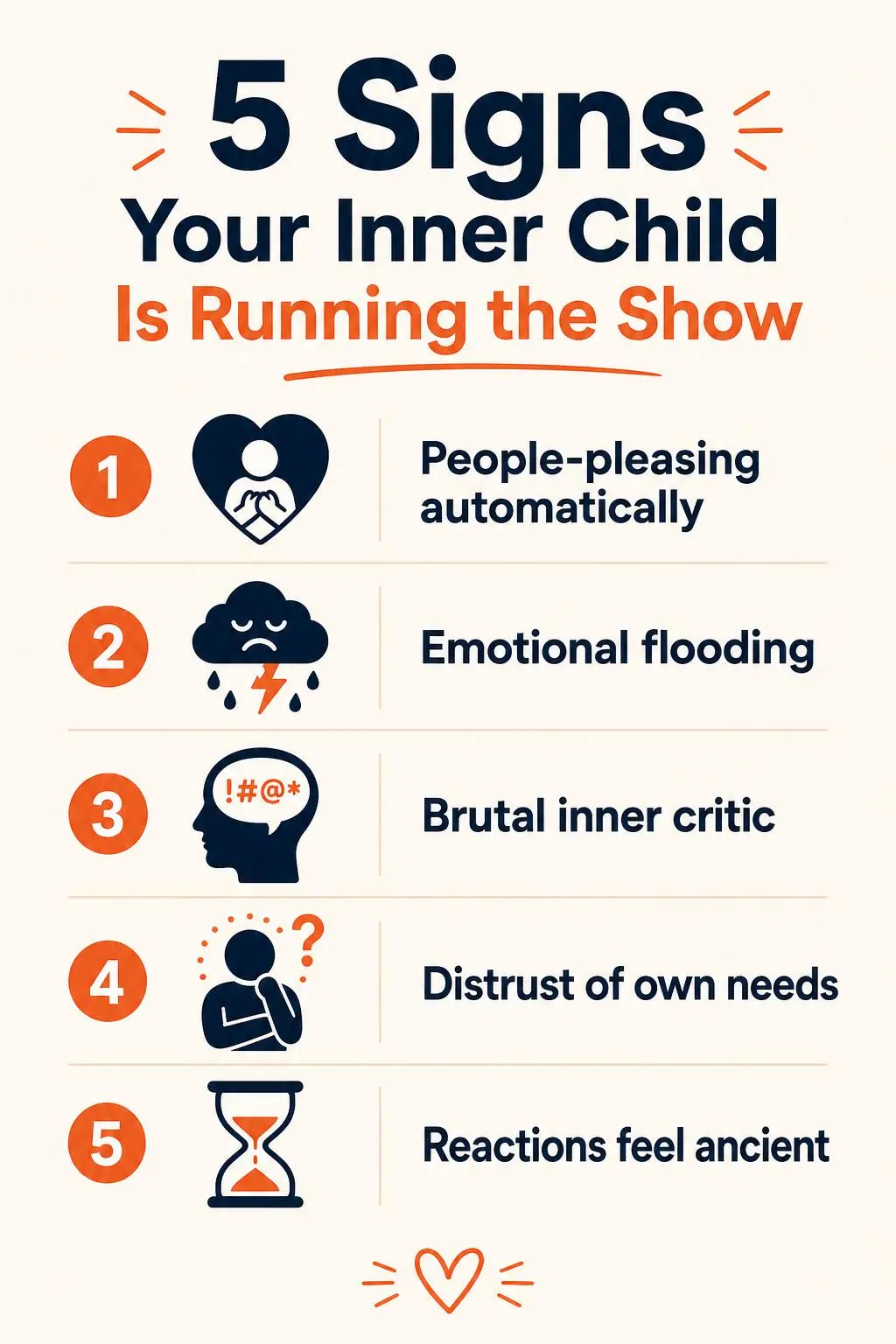
You people-please almost automatically
Saying no feels dangerous, not just uncomfortable. You agree to things you quietly resent, you manage other people's moods before they even ask, and you feel responsible for how everyone around you is doing. This often traces back to a childhood where love felt tied to compliance. We see this constantly in our work on enmeshment trauma, where children learn early that their value lives in taking care of other people's feelings.
You get flooded fast
Someone raises their voice and you freeze. Your partner says they need space and your heart pounds like you are about to be left for good. A coworker sends a short email and you spend the next three hours deciding if they hate you. The reaction is real. It is also almost always bigger than what is actually in front of you. That gap between the moment and the reaction is usually where the younger part of you is living.
Your inner critic is brutal
The voice in your head is not just firm. It is mean. It sounds like someone from your past. It tells you that you are too much, not enough, a disappointment, or just broken. Many of our clients are surprised by how harsh that voice is, because they have been hearing it for so long it just feels like the truth.
You do not trust your own needs
You feel something, then immediately question it. "Am I overreacting? Maybe I should not need that. Other people have it worse." If your childhood taught you that your needs were a burden or an inconvenience, you learned to distrust the signals your own body sends you.
Certain moments feel much older than they are
Conflict, criticism, feeling left out, not being picked, being dismissed. Some of these hit a nerve that feels ancient. That is because it is. Your nervous system carries memory, and sometimes it is responding to 1994, not today. This connects to attachment patterns formed in childhood that we help people understand and work through in session.
What Inner Child Wounds Actually Come From
One of the most important things we want you to hear: your childhood does not have to have been terrible for you to carry real wounds from it.
We work with people whose childhoods looked completely fine from the outside. People whose parents loved them and also could not manage their own emotions. People who were never hit but were constantly criticized. People who had every material thing they needed but never felt truly seen or known.
Inner child wounds often come from:
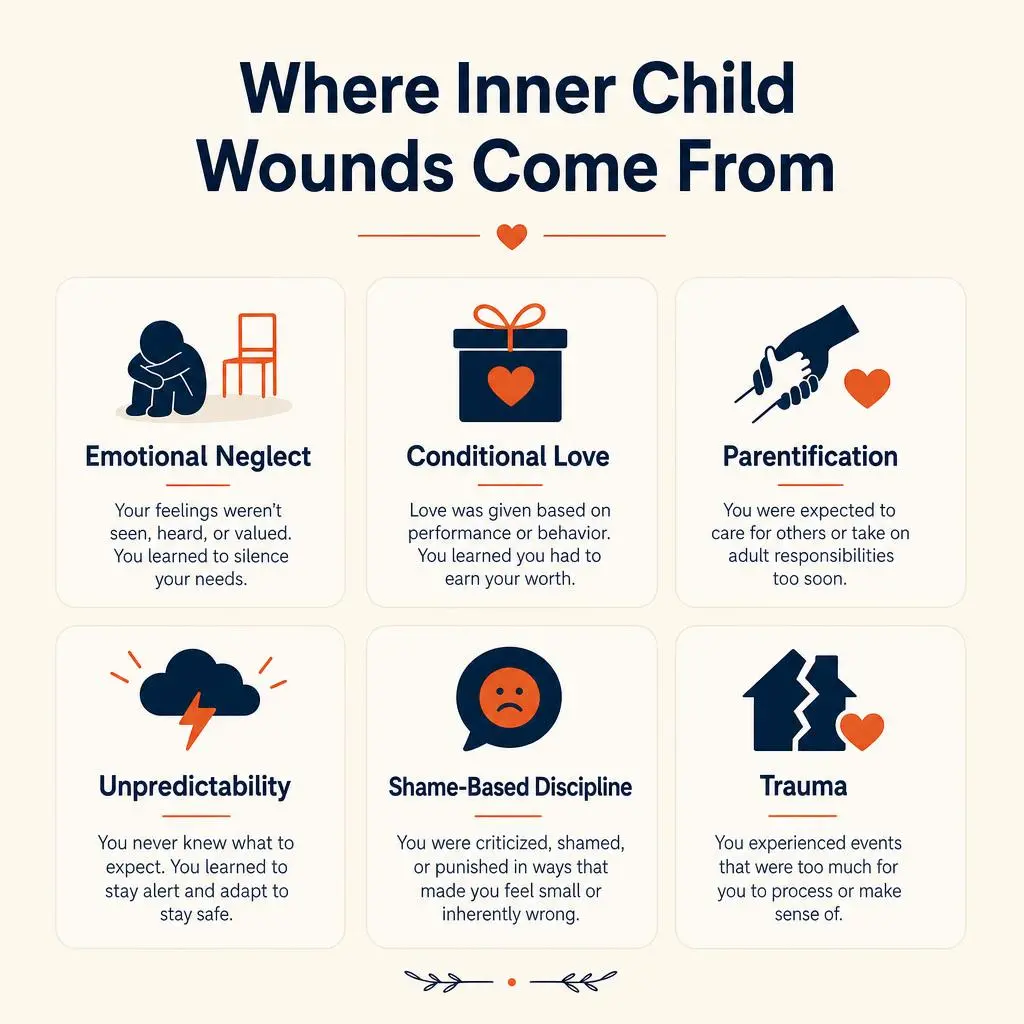
- Emotional neglect. Not abuse, but absence. A parent who was physically there but emotionally checked out. You learned that your feelings were not worth responding to.
- Conditional love. Affection that depended on performance, good behavior, or hitting the right marks. You learned: I am loved when I get it right. When I mess up, I am on my own.
- Being parentified. You were expected to manage a parent's moods, be their confidant, or hold the family together emotionally. This is often at the root of chronic people-pleasing in adults. We cover this in depth in our article on enmeshment trauma.
- Chronic unpredictability. A parent whose moods were hard to read, and you never knew which version of them was walking through the door. You became hypervigilant, always scanning the room for what was coming next.
- Shame-based discipline. Being told you were bad rather than that you did something bad. The message that landed: there is something wrong with you at the core.
- Actual trauma. Abuse, loss, violence, or deep instability. The kind of experiences that leave marks in the body, not just in memory.
Here in Utah, we also see a specific layer for many of our clients: the way these wounds overlap with religion, culture, and family loyalty. The message that obedience equals love, that questioning is betrayal, that your needs should always come last. That is real, and we are not afraid to sit with it in session.
Wondering If This Is What You're Carrying?
We help adults in Salt Lake County and Davis County make sense of old wounds and find a real way forward. You do not have to keep doing this on your own.
Schedule an AppointmentWhat Inner Child Work Looks Like in Therapy
Inner child work is not one specific technique. It is a way of approaching the younger parts of yourself with curiosity and care instead of frustration or shame. In session, it might look like several different things depending on what you need.
Talking about what actually happened
Not to relive it or get stuck in the past, but to name it out loud and start separating what happened to you then from what is happening now. Many of our clients have never said some of these things to another person. That act alone starts to shift something.
Parts work and Internal Family Systems (IFS)
IFS is a therapy approach built on the idea that we all have different parts of ourselves: a people-pleaser, an inner critic, a protector, a hurt younger part. Inner child work happens a lot here. We help you get to know these parts, understand what each one has been trying to do for you, and build a better working relationship between them and your adult self. It is not as strange as it sounds. For a lot of clients, it is the most concrete and useful work we do.
EMDR for childhood memories
EMDR therapy is one of the most effective tools we have for working with old memories that still carry weight. When a specific memory from childhood keeps coming back, a moment of humiliation, a time you were left alone, the look on someone's face, EMDR helps your brain process it so it stops hitting your nervous system the same way. The memory does not disappear. It just loses its hold on you.
Reparenting
This is the practice of learning to give yourself, as an adult, what your younger self never received. That might mean learning to sit with your own feelings instead of dismissing them right away. Learning to set a limit without spiraling in guilt afterward. Learning to talk to yourself the way you would talk to a child you care about. It is simple to describe and genuinely hard to do. Many clients find this connects directly to how they show up in their relationships, because how we treat ourselves tends to set the ceiling for how we let others treat us.
Paying attention to the body
Childhood experiences do not only live in memory. They live in the body. Tightness in your chest when someone criticizes you. A sick feeling before conflict. The urge to go quiet and small when someone looks at you too long. We pay attention to where feelings land physically, because that is often where the old wound is actually sitting. This connects to the physical symptoms of trauma we work with regularly.
Looking honestly at the beliefs you formed early
A lot of inner child wounds come packaged with beliefs that stuck: "I am not enough." "I am a burden." "People always leave." Using tools from cognitive behavioral therapy, we help you look at where those beliefs came from, whether they actually hold up, and what a more accurate story sounds like. This is not about forcing yourself to think positively. It is about being honest.
How to Start Safely, Even on Your Own
We want to be direct about this: deep inner child work is best done with a therapist. Going into old wounds without support can be destabilizing, especially if what you are carrying includes significant trauma or PTSD. Safety comes first.
That said, there are things you can do between sessions, or even before your first one, that start to open the door in a gentle way.
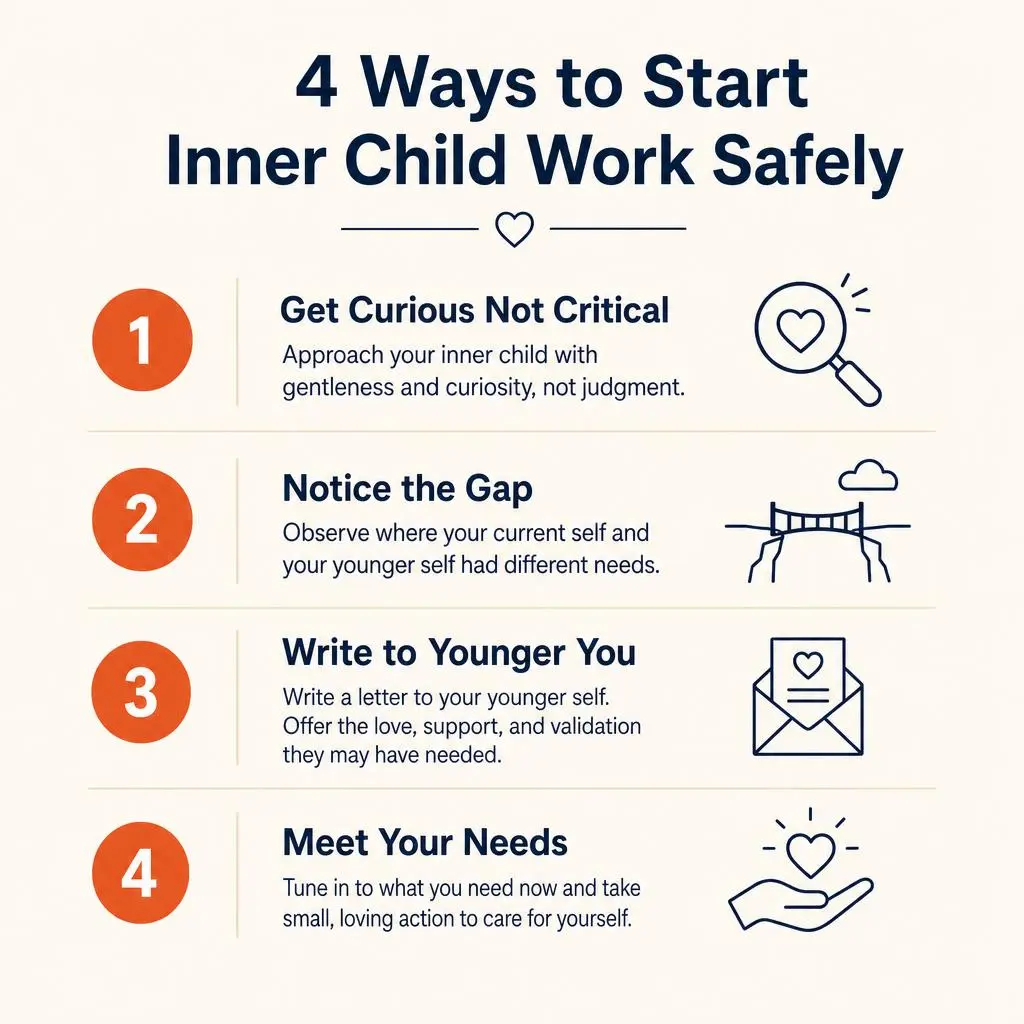
1. Get curious instead of critical
The next time you notice a reaction that feels bigger than the moment calls for, try asking: "How old does this feel?" instead of "What is wrong with me?" That shift, from judgment to genuine curiosity, is where inner child work begins. You are treating your reaction as information rather than something to be ashamed of.
2. Notice what sets you off
Pay attention to what situations, tones of voice, or dynamics tend to pull you into an outsized reaction. Not to analyze it endlessly, but just to notice. Seeing the pattern is the first step. If you find yourself feeling anxious and on guard in ways that seem out of proportion to what is actually in front of you, our article on hypovigilance may resonate. It is closely connected to how we learned to protect ourselves early on.
3. Write a letter to your younger self
This feels awkward for almost everyone at first. Try it anyway. Think of a time in childhood when you were struggling. Write to that version of you, not to analyze what happened, but just to acknowledge it. To say: I see what you were carrying. That was too much for a kid. You did the best you could. A lot of people are surprised by what comes up. A lot of people cry. That is not a bad sign.
4. Practice meeting your own needs without explaining yourself
Start small. If you are tired, rest. If you are hungry, eat. If you need a minute before responding to something hard, take it. These small acts of following through on what you actually need are reparenting in real time. They send a message to the younger part of you: your needs are allowed here.
When Inner Child Work Might Feel Too Intense
We want to be straight with you here, because you deserve honesty more than reassurance.
Inner child work can stir things up. For some people, particularly those with a trauma history, complex PTSD, or real instability in their current life, jumping straight into this kind of work without solid footing in place can feel like too much too fast.
That is not a reason to avoid it. It is a reason to do it carefully.
If any of the following are true for you right now, please tell us before we start this work together:
- You are in a living situation that is currently unsafe or unstable.
- You have a history of dissociation or losing stretches of time.
- You have a hard time managing your emotions day to day.
- You are in a mental health crisis right now, or having thoughts of harming yourself.
None of those things disqualify you from healing. They mean we build the groundwork first. We make sure you have real coping skills and enough stability before we open doors that might be hard to close in a single session. That is just good trauma care.
If you are in crisis right now, please contact a crisis line or emergency services. You do not have to manage this on your own.
You Do Not Have to Go Back There Alone
Here is what we know after working with hundreds of adults across Utah:
The people who come to us are not broken. They are people who learned, very early, how to survive in an environment that was not always safe or steady. And those coping patterns have been going ever since, long past the point where they were needed.
Inner child work is not about going back and drowning in the past. It is about finally giving that younger part of you what it always needed: someone to show up, pay attention, and say clearly: you mattered then. You matter now. And we are going to figure this out together.
If you are ready to take that step, we are here. We offer in-person sessions at our Murray and Kaysville locations, and secure virtual sessions from anywhere in Utah.
Ready to Start This Work?
We help adults in Salt Lake County and Davis County work through the wounds that have been quietly running things. In person or online. We are here.
Schedule an Appointment