
Healthy relationships are not always perfectly balanced. Real balance is more like a gentle give and take. Sometimes you give more, and other times your partner does. Over time, things even out so both people feel safe, loved, and treated fairly.
When I meet with couples in therapy, many ask for "more balance." They usually do not mean splitting everything 50/50. What they really want is to feel seen, supported, and not alone in making the relationship work.
In this article, I'll share simple, everyday examples of balance. I'll also talk about what imbalance feels like and offer small steps to help you find your way back.
What Do We Mean by Balance?
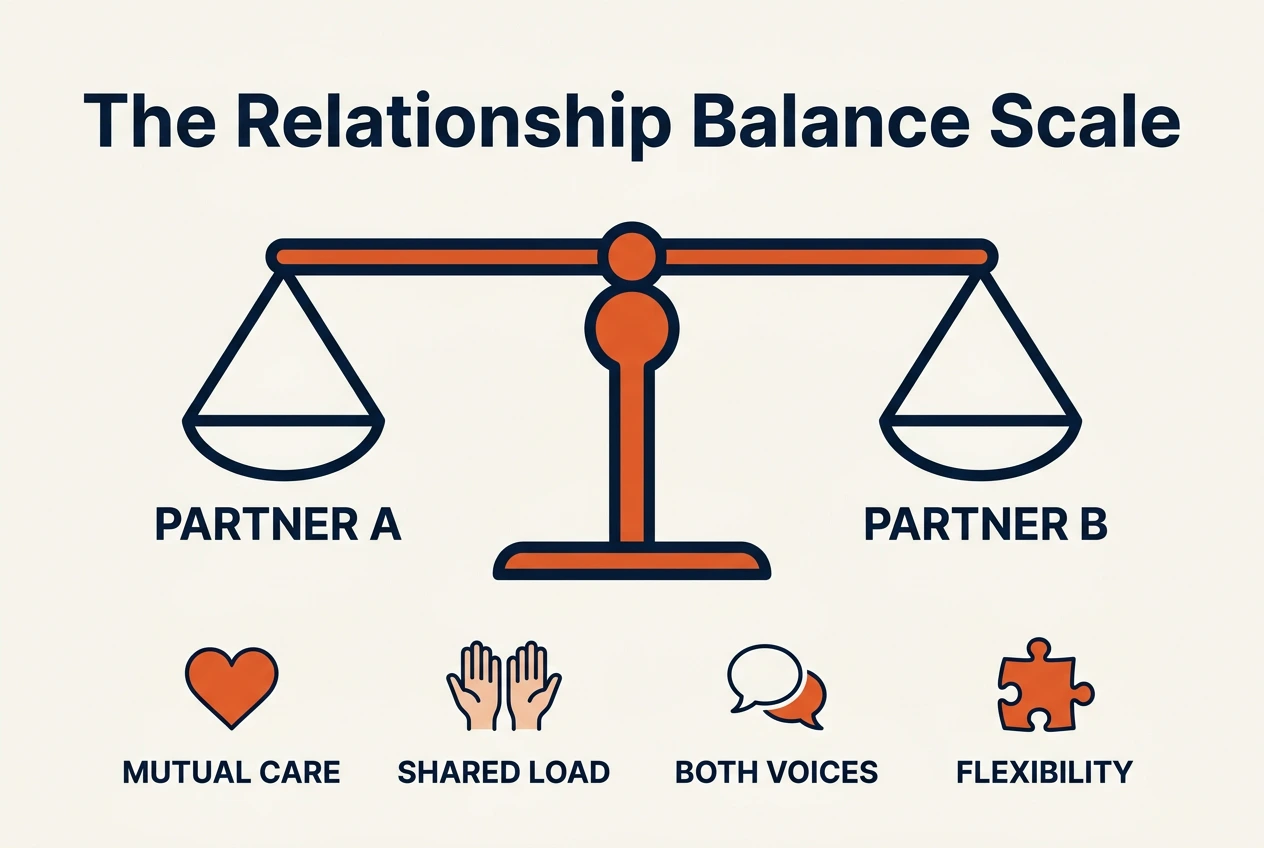
Balance in a relationship is:
- Shared responsibility instead of one person carrying everything
- Mutual care instead of one person always giving and the other mostly receiving
- Room for two truths instead of only one person's feelings mattering
- Flexibility instead of rigid rules about who must do what
Balance is not about keeping score. It is not, "I did the dishes three times, so you owe me three times." Instead, it is a sense of fairness and partnership that builds over weeks, months, and years.
I often ask couples, "If your relationship were a scale, which side feels heavier right now, and why?" Their answers help us see where to focus.
Example 1: Emotional Balance – Who Gets to Have Big Feelings?
One of the clearest signs of balance is how you both handle emotions.
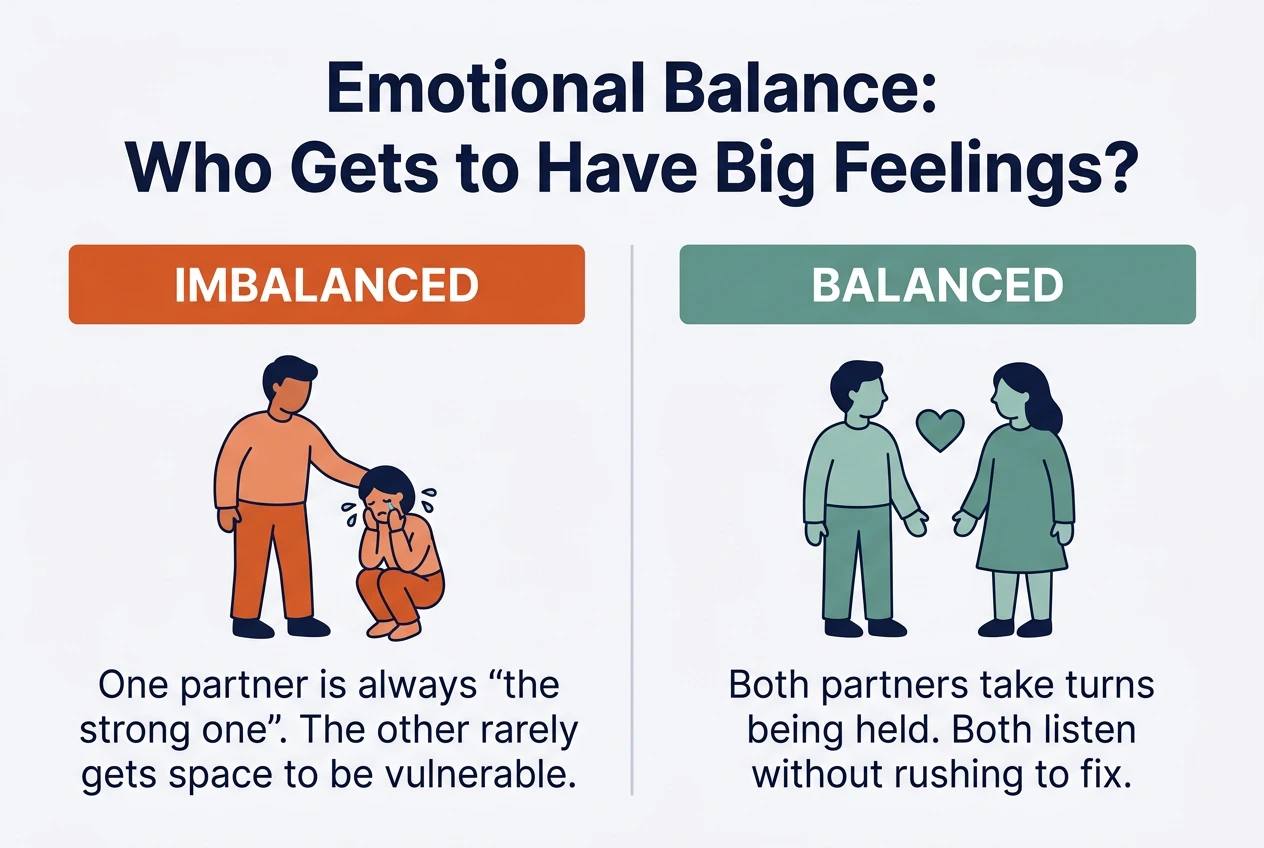
In many relationships, one partner becomes the "strong one." This person holds things together, comforts the other, and tries to keep the peace. Over time, they might start to feel invisible or resentful.
What imbalance can look like
I worked with a couple where one partner, I will call her Maya, often broke down in tears after conflicts. Her partner, Alex, would shift into problem solving. He wiped her tears, reassured her, and tried to fix things quickly. Maya felt cared for in those moments.
But when Alex felt sad or overwhelmed, he stayed quiet. He told me, "I do not want to add more stress for her." When he did open up, Maya felt scared and shut down. She would say, "I cannot handle this right now," and walk away.
Over time, Alex realized there was not much space for his feelings. Maya could express her sadness, but he could not.
That is emotional imbalance. Patterns like this can sometimes connect to anxious preoccupied attachment style or dismissive avoidant attachment style.
What balance can look like
Balanced emotional support means:
- Both people get to be vulnerable. Some weeks one of you needs more holding. Other weeks, it shifts.
- You both practice listening without fixing. You say things like, "I hear you," "That makes sense," or "I am here with you," instead of jumping to solutions.
- You check in on each other's inner world. You might say, "You asked about my day, and I appreciate that. I also want to hear how you are doing."
I often invite couples to try this simple practice:
It might feel awkward at first, but many couples say this is the first time they have really listened to each other in a long time.
Example 2: Practical Balance – Who Carries the Daily Load?
In therapy, I hear many versions of the same story:
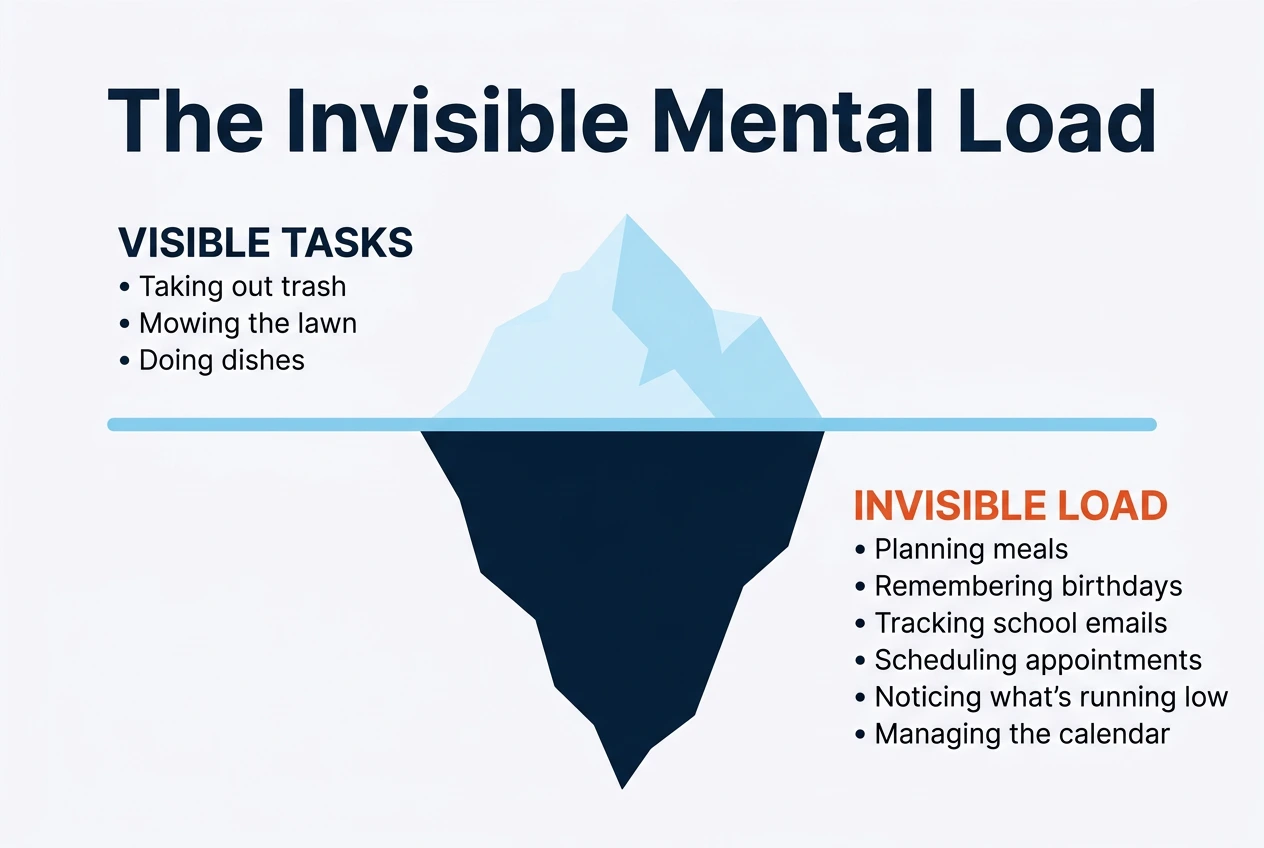
This is about invisible labor: planning meals, remembering birthdays, keeping up with school emails, and noticing what the household needs next.
What imbalance can look like
I remember a couple who argued often about the dishwasher. On the surface, it sounded petty. Underneath, it was about feeling alone in the work.
One partner, Sam, said, "I feel like I run this whole house and then I have to ask you to do basic things." Their partner, Jordan, felt attacked. "You make it sound like I do nothing. I take out the trash and handle the yard."
When we listed out tasks, we saw the pattern:
- Sam handled most of the mental load: planning, scheduling, tracking details.
- Jordan handled a few visible tasks, but did not notice what else needed to get done unless told.
Sam did not just want help with chores. Sam wanted a partner who could notice what needed to be done without always being told.
What balance can look like
Balanced responsibility does not always mean splitting every task in half. It often means:
- You each own certain areas fully
- You talk openly about what feels fair
- You revisit the plan during life changes
An example of balanced conversation might sound like:
Some couples I work with create a simple weekly ritual:
- On Sundays, they look at the week together
- They divide tasks based on energy and time, not just habits
- They check in midweek and adjust
It is not about being perfect. It is about both partners feeling like teammates, not like a manager and an assistant. Tools from cognitive behavioral therapy can be especially helpful here.
Curious What Balance Could Look Like for You?
At Phoenix Rebellion Therapy, we help couples build more ease, fairness, and mutual care into their relationships.
Schedule an AppointmentExample 3: Balance Between Togetherness and Space
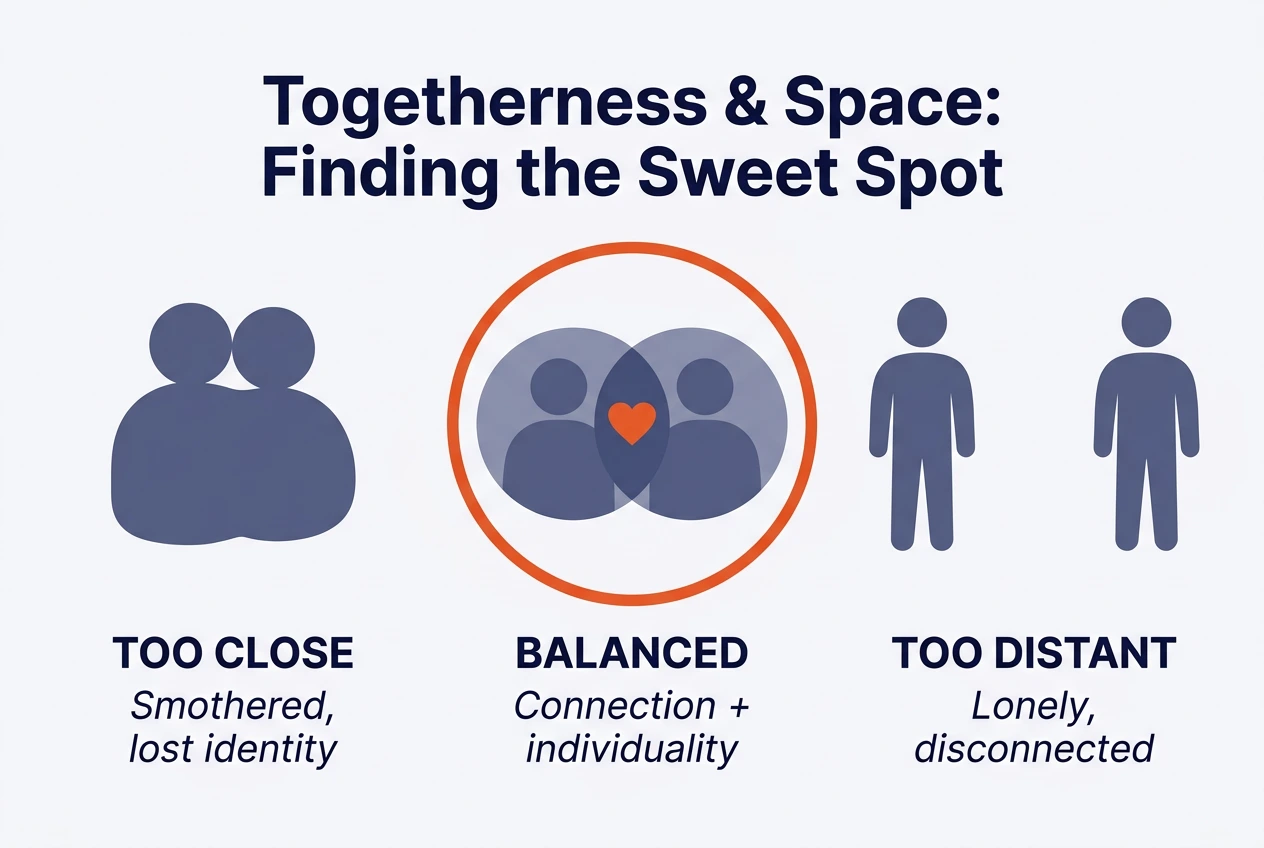
Healthy relationships need both time together and time apart.
When there is imbalance, one person may feel smothered while the other feels abandoned.
What imbalance can look like
In one session, a partner said, "If we are not doing everything together, it feels like you do not care about me." The other partner replied, "If we do not have some separate time, I feel like I disappear."
Neither person was wrong; they just had different needs.
Imbalance can show up when:
- One partner gives up hobbies or friendships to avoid conflict
- The other feels guilty for wanting alone time
- Requests for space get misread as rejection
What balance can look like
Balanced togetherness often sounds like:
I often encourage couples to create what I call "connection anchors":
- A consistent check in, maybe 15 minutes each evening
- One planned shared activity each week, even if it is simple, like a walk or cooking dinner together
Once couples have these anchors, it feels safer to spend time apart. You both know you will reconnect in a real and predictable way.
Example 4: Balance in Power and Decision Making
Power in relationships can be subtle. It shows up in who decides:
- How money is spent
- How time is used
- How conflicts are resolved
What imbalance can look like
I have seen couples where one partner decides most things because they "care more" or are "better at planning." Over time, the other partner stops offering opinions. They may tell themselves it is easier this way.
Then, a conflict happens. The quieter partner says, "You never listen to me," and the other feels confused. "You never say what you want."
The truth is, both people play a part in the imbalance. One takes more power, and the other gives it away.
What balance can look like
Balanced power does not mean you must agree on everything. It means:
- You both have a say in choices that affect you
- You take each other's preferences seriously
- You slow down big decisions so both voices can be heard
A more balanced pattern might sound like:
Sometimes I ask couples to practice making small decisions together, like what to watch, where to eat, or how to spend a free hour. The goal is not to make the perfect plan, but to learn how to talk and work together.
Example 5: Balance in Repair After Conflict
Every couple fights. What matters is how you come back together.
Imbalance in repair shows up when one person always:
- Apologizes first
- Reaches out to reconnect
- Suggests ways to improve next time
The other partner may wait, withdraw, or assume that if the first person wants to talk, they will come forward.
What imbalance can look like
I often hear something like:
This pattern feels lonely and heavy for the person who always reaches out. The other partner may not realize how much pressure this puts on them.
What balance can look like
Balanced repair might look like:
- Sometimes you are the first to say, "I am sorry." Other times, your partner is.
- You both learn to name your part without collapsing into shame.
- You both care about how your conflict lands on each other.
A simple way to build balance is to practice shared language after a conflict. You might say:
- "Here is the part I see in myself that I want to work on."
- "Here is what I wish I had done differently."
- "Here is what I appreciate about how you came back to me."
Over time, the goal is for both of you to feel that you help heal the relationship.
How You Can Start Bringing More Balance Into Your Relationship
You do not have to fix everything right away. I often suggest couples start with gentle curiosity.
Here are a few steps you can try:
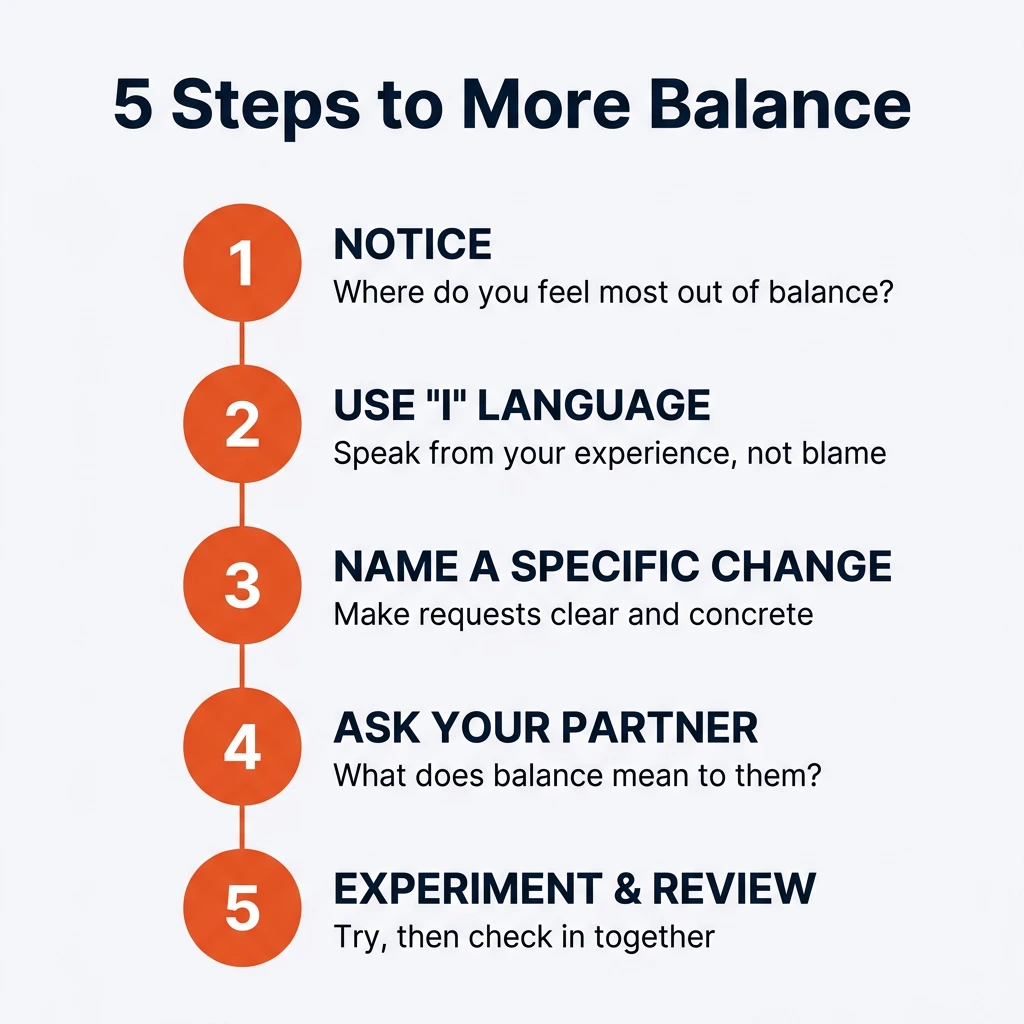
- Notice where you feel most out of balance. Is it emotions, chores, time together, money, parenting, sex, or conflict repair?
- Use "I" language instead of blame. For example: "I feel overwhelmed when I handle all the planning," instead of, "You never help."
- Name a specific change you would like. Vague requests lead to vague results. Try, "Can we sit down once a week to divide tasks," instead of, "I need you to step up."
- Ask your partner what balance means to them. You might be surprised. Sometimes your partner is also feeling imbalance, just in a different area.
- Experiment and review. Try a small change for two weeks. Then ask, "What is working, and what still feels heavy?"
When I work with couples, I remind them that balance is an ongoing process, not a final goal. You adjust as life changes. New jobs, illness, children, grief, and growth all change what balance means.
When You Might Need Extra Support
Sometimes imbalance has deep roots. Maybe you grew up in a home where it was not safe to share your needs. Maybe you learned that love means always taking care of others. Maybe you never saw examples of healthy, mutual relationships.
In those cases, you might know your relationship is unbalanced, but feel stuck about how to change it.
Therapy can help you:
- Understand your patterns with compassion, not judgment
- Learn to speak your needs clearly and kindly
- Practice new ways of relating in a safe space
At Phoenix Rebellion Therapy, we see balance as a way to heal and stand up for yourself. You deserve relationships where your voice matters, your needs count, and your care is valued.
You do not have to carry everything by yourself. You can learn, step by step, how to build a relationship where both of you feel steady and supported.
If you and your partner are curious about what balance could look like for you, it can help to explore that with support. It is okay to want more ease, fairness, and mutual care. Wanting these things is not selfish - it is healthy. Many people also benefit from understanding related patterns like enmeshment trauma or hypovigilance.
Ready to Build a More Balanced Relationship?
We offer in-person sessions at our Murray and Kaysville office locations, as well as virtual sessions over secure video conferencing from anywhere in Utah.
Schedule an Appointment