
Here is something we see over and over in our practice: some of the most capable, caring, hard-working people we have ever met genuinely believe they are not good enough. Not in a passing, bad-day kind of way. In a deep, settled, this-is-just-the-truth kind of way.
They have accomplishments. They have people who love them. And yet, underneath all of that, there is a voice that keeps the score differently. It files away every mistake and overlooks most of the wins. It compares constantly, assumes the worst, and offers very little grace.
That voice is not telling the truth. But it is very convincing, especially when it has been there for years.
A negative self image is not a personality type or a character flaw. It is something that gets built, usually piece by piece, usually long before you had any say in the matter. And because it was built, it can be rebuilt. Not with affirmations or forced positivity, but with real, honest work that gets at where it actually came from.
That is what this article is about, and it is what we help people do every day.
What Is a Negative Self Image?
Your self image is the internal picture you carry of yourself. Not just your appearance, but your worth, your capabilities, your likability, and whether you belong. It is the answer your brain gives when it asks: who am I, and do I measure up?
According to Simply Psychology, self image is a mental representation that shapes how we interpret our experiences and interact with the world around us. When that picture is mostly unflattering, we call it a negative self image.
The tricky part is that a negative self image does not feel like a picture. It feels like an accurate assessment. People who have one are not being dramatic or fishing for reassurance. They genuinely believe what they believe about themselves, because those beliefs got wired in early and have been reinforced for a long time.
What makes this different from just having a rough week or feeling insecure in a specific situation is the consistency. A negative self image is the background noise that is almost always on. It shapes how you walk into a room, how you respond to feedback, whether you speak up or stay quiet, and what you believe you deserve in relationships and in life.
James, our clinical director and licensed clinical social worker, puts it this way: "A negative self image is not about what is actually true. It is about what a person was taught to believe, usually by experiences they had no control over. Once someone can see it as a learned story rather than a fact, that is when real change becomes possible."
How to Tell If You Are Dealing With One
A negative self image does not always look like obvious insecurity from the outside. In fact, a lot of the people we work with come across as confident, put-together, even high-achieving. The struggle is mostly internal and mostly hidden. Here is what it tends to look like up close:
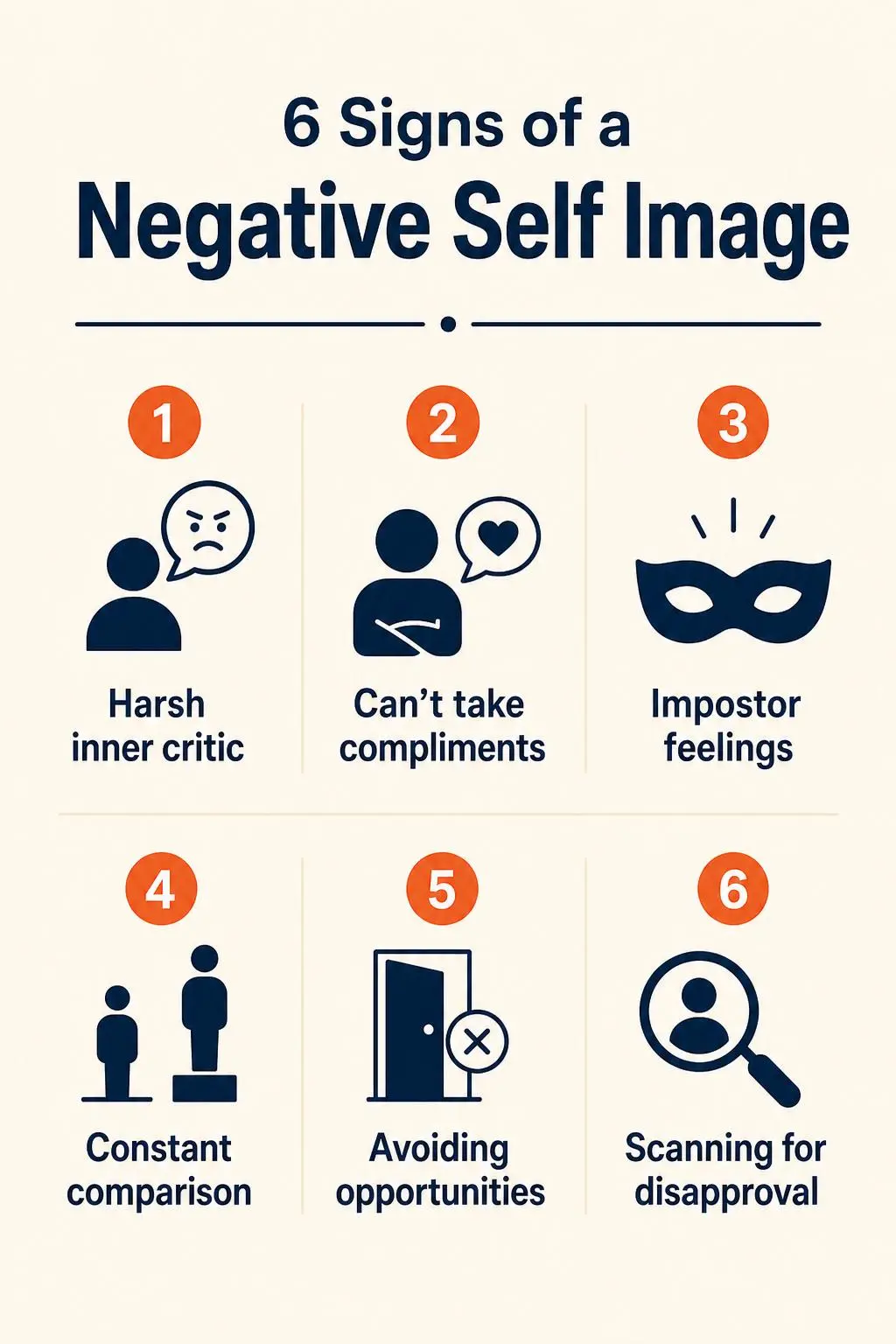
The inner critic never takes a day off
Most people have an inner critic. With a negative self image, that critic is running almost constantly. It replays mistakes at 2am. It points out everything wrong with how you handled something before you have even left the room. It is not just firm; it is mean. And it holds you to a standard you would never apply to someone you care about.
Compliments do not land
When someone praises your work, your first move is to deflect, argue with it, or find the reason they are wrong. "They do not know the whole story." "They are just being nice." Positive feedback bounces off because it does not match the picture you are already holding. This is one of the clearest signs we look for in session.
You feel like you are waiting to be found out
Your accomplishments feel like flukes. The people who respect you seem to be overestimating you. At some point, you tell yourself, they will figure it out. This is often called impostor syndrome, and it is almost always rooted in a self image that decided long ago that you are not really good enough. External achievements rarely touch it, because the problem is not your track record.
Comparison is constant and always goes the same way
You scroll through social media and feel worse afterward. You walk into a room and immediately measure yourself against the people in it. And somehow, the comparison almost always confirms that others have more, are doing better, or seem to have it more figured out than you do. As research on self-concept shows, we naturally form our self image partly through social comparison, which is why the people and images we surround ourselves with matter more than most of us realize.
You make yourself smaller to avoid being judged
You do not send the application. You stay quiet when you have something worth saying. You turn down things that might expose you to failure or rejection. This feels like self-protection. Over time, though, it shrinks your world and quietly confirms the belief that you were not capable anyway.
You are always scanning the room for signs of disapproval
A slow text response becomes a sign someone is upset with you. A distracted expression in a meeting means you did something wrong. This hypervigilance is exhausting and it is closely connected to what we describe in our piece on hypovigilance. When your self image is fragile, you are always on the lookout for evidence that confirms the worst.
Where It Comes From
This is the part we want to spend real time on, because understanding the roots of a negative self image is what makes it possible to actually change. You were not born with this picture of yourself. It was built in response to things that happened to you, most of them before you had the cognitive tools to evaluate whether the messages were true.
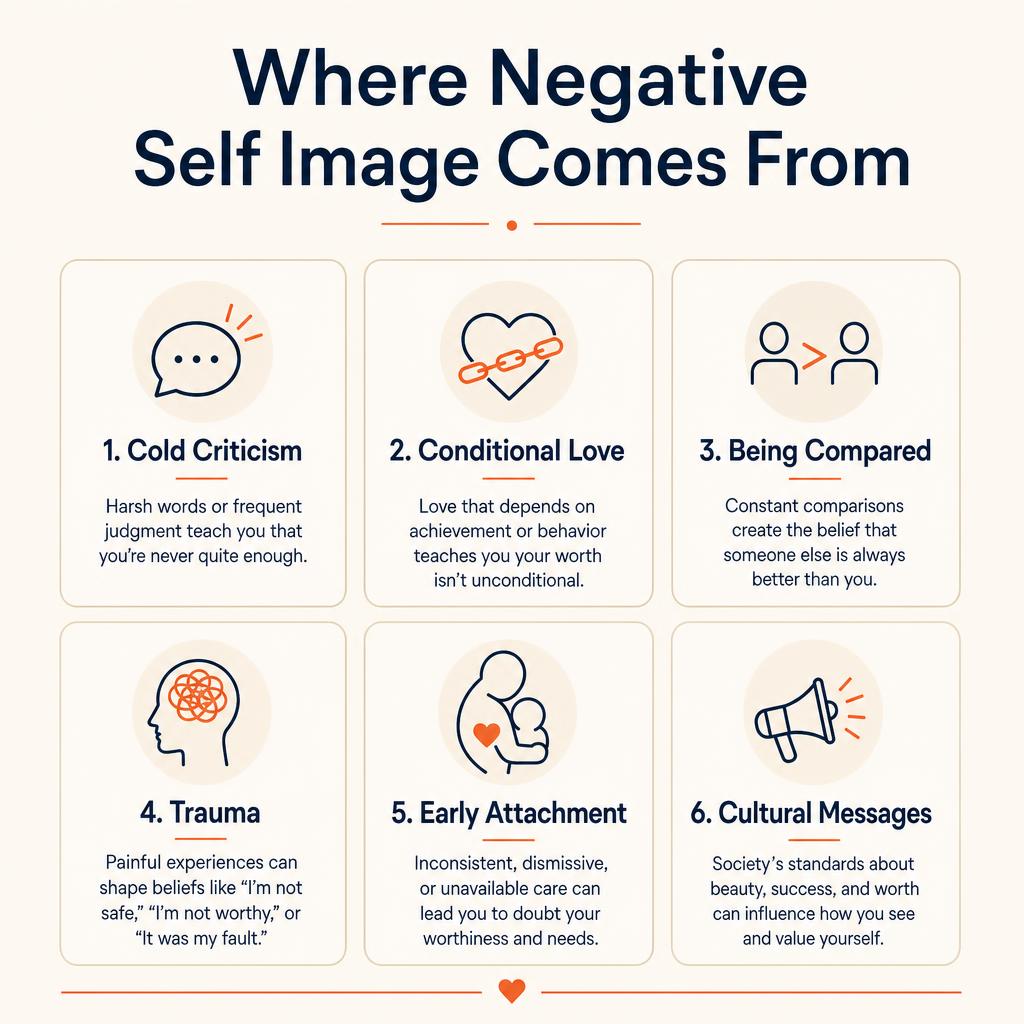
Research worth knowing: According to Simply Psychology, children are particularly vulnerable to accepting negative judgments from authority figures because they have not yet developed the ability to critically evaluate those comments. The messages land as facts, not opinions.
Criticism without enough warmth to balance it
Parents and teachers who were quick to correct and slow to encourage. Homes where what was wrong got pointed out far more than what was right. Families where love was present but rarely said out loud, and mistakes were treated as character evidence rather than normal parts of growing up. None of this requires cruelty. It just requires an imbalance that a child's developing sense of self cannot easily absorb.
Love that felt like it had conditions attached
When approval and affection depended on your grades, your behavior, your mood, or how well you met someone else's expectations, you learned a very specific lesson: I am acceptable when I perform well. When I fall short, I am on my own. This kind of dynamic is at the heart of what we see in enmeshment trauma, where a child's worth becomes tied to their usefulness or compliance rather than simply to who they are.
Bullying and peer rejection
The research here is clear and worth taking seriously. A meta-analysis cited by the American Psychological Association found that childhood bullying victims are 2.5 times more likely to develop low self-esteem in adulthood. Being mocked, excluded, or made to feel like an outsider during the years when your sense of self is forming leaves a mark that does not just fade when school ends.
Trauma and difficult early experiences
Abuse, neglect, loss, chronic instability. These experiences do not only create emotional pain. They tend to generate very specific beliefs: I am the problem. I am not worth protecting. I deserved this. We see these beliefs consistently in our work with trauma and PTSD, and they are among the most stubborn parts of the work to address because they feel so thoroughly true. They also show up in the body in ways that are worth paying attention to, as we cover in our piece on the physical symptoms of PTSD.
Early attachment experiences
The first relationships you had taught you something about whether you were worth showing up for. If those relationships were inconsistent, dismissive, or emotionally unavailable, the most available explanation to a young child is almost always some version of: there must be something wrong with me. We talk about how this plays out in adult life in our article on dismissive avoidant attachment.
Constant comparison in a filtered world
This one is newer but it is not small. Research published in PMC found that even brief exposure to idealized images reduces self-esteem in a significant portion of participants, particularly among women. Social media did not create insecurity, but it does give it a constant feed. When your baseline picture of yourself is already fragile, that daily input matters.
The Cycle That Keeps It Going
One of the most important things we explain to clients is that a negative self image does not just sit there passively. It actively works to protect itself. It filters information to confirm what it already believes and dismisses information that challenges it.
In our practice, we see this play out in a very consistent cycle:
- You hold a belief: "I am not competent / not likable / not enough."
- That belief shapes your behavior: you avoid challenges, over-explain yourself, shrink in social situations, or work twice as hard to prove you belong.
- Those behaviors produce outcomes that seem to confirm the belief: you do not get the opportunity you did not go for. You feel exhausted and resentful from over-giving. You stay invisible in rooms where you wanted to be seen.
- The belief gets reinforced: see, I knew it.
This is why telling someone to just be more confident rarely works. The confidence is not the problem. The underlying belief is. And beliefs that were formed early and reinforced for years do not budge from a pep talk. They require a different kind of work.
Ready to Work on the Picture You Carry?
We help adults across Salt Lake County and Davis County change the story they carry about themselves. In person in Murray or Kaysville, or online anywhere in Utah.
Schedule an AppointmentHow We Help in Therapy
When someone comes to us with a negative self image, we are not just working on thoughts. We are working on the whole picture: the beliefs, the patterns, the memories that reinforced those beliefs, and the way it all shows up in their relationships and daily life. Here is what that typically involves:
Getting specific about where the beliefs came from
Most negative self image beliefs have a specific origin. A parent's voice. A teacher's comment. A relationship that confirmed your worst fears about yourself. When we trace a belief back to its source, it starts to look less like a universal truth and more like a conclusion a much younger version of you drew under circumstances they had no control over. That is not a small shift.
Challenging the thoughts, not just observing them
Using tools from cognitive behavioral therapy, we help you examine the specific thoughts that make up your negative self image and test them against what is actually true. Research published in Frontiers in Psychology supports CBT as an effective approach for improving self-esteem, particularly through helping people identify negative self-critical patterns and reconstruct them based on real evidence. This is not about positive thinking. It is about accuracy.
Processing the memories that still carry weight
EMDR therapy is one of the most effective tools we have for working with memories that are still actively shaping how you see yourself. The same study in Frontiers in Psychology found that both CBT and EMDR produced significant improvements in self-esteem, with EMDR showing particular effectiveness when the negative self image is rooted in specific painful memories. When your brain stops responding to an old memory with the same intensity, the belief attached to it often loosens too.
Working on how it shows up in your relationships
A negative self image rarely stays private. It shows up in how much you ask for, how much you tolerate, and how you respond when someone gets close. We pay close attention to this in our work together, often alongside conversations about finding balance in relationships and the patterns that form when one person does not feel like they deserve equal footing.
Addressing the body, not just the mind
Shame and self-criticism live in the body, not just in thoughts. Tightness, hunched posture, the way some people make themselves physically small in a room. Accelerated Resolution Therapy (ART) is one of the tools we use to work with the physical and sensory dimensions of these experiences, particularly when the negative self image is tied to trauma or body-based shame.
Building an honest picture to replace the distorted one
This is the longer-term work. Not replacing a harsh inner critic with a cheerleader, but developing a genuinely fair and accurate view of yourself. One that acknowledges your struggles honestly and also refuses to leave out the parts that contradict the negative story. For many clients, this is also connected to the inner child work we do, because the child who formed those early beliefs often needs to be tended to directly, not just thought about.
Steps You Can Take Right Now
Deep self image work is most effective with a therapist. But there are things you can begin doing today that build real momentum. These are not quick fixes. They are small, consistent actions that start to loosen the grip of the old story over time.
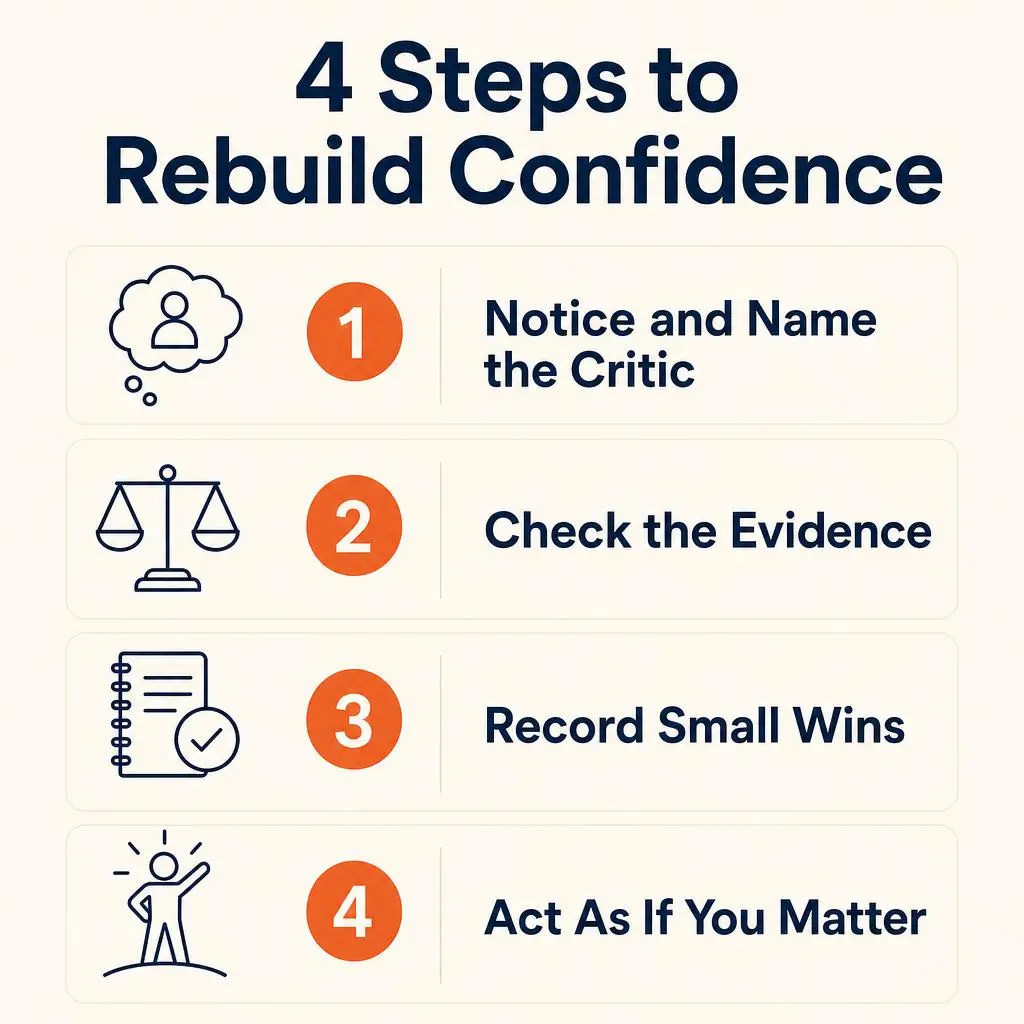
1. Name the critic rather than becoming it
When the harsh internal voice shows up, try noticing it as a voice rather than as the truth. Some people find it helps to give it a name, not to be dismissive of the pain it causes, but to create a small separation between you and it. "There's that voice again." That gap, small as it is, is where change starts. You are not the critic. You are the person listening to it. Those are different things.
2. Test the belief against the actual evidence
When the inner critic makes a claim, treat it like a hypothesis rather than a fact. What is the evidence for it? What is the evidence against it? What would you say to a close friend who told you they believed the same thing about themselves? Most people are genuinely surprised by how one-sided their inner critic's case actually is when they look at it directly.
3. Keep a running record of things you handle well
A negative self image filters out positive information constantly. It notices failure and files it carefully. It lets success slide by without comment. A simple, ongoing record of things that went well, not trophy-worthy moments, just normal evidence of competence, fairness, and care, starts to create a counter-record that is harder for the brain to ignore. This is not a gratitude journal. It is a reality check.
4. Do one thing today that the avoidance has been blocking
Pick one small thing you have been avoiding because the negative self image said the outcome would confirm your fears. Send the message. Speak up in the meeting. Try the thing you keep talking yourself out of. The goal is not to nail it perfectly. The goal is to break the pattern of avoidance, even once, and collect a small piece of evidence that the story you have been telling yourself is not the whole picture.
You Do Not Have to Keep Living Inside That Story
We work with a lot of adults who have been carrying a negative self image for so long that they have stopped questioning it. It just feels like who they are. The self-doubt, the inner critic, the constant comparison. It is familiar, and familiar feels like true.
You do not have to demolish the old picture before you can build a better one. You just have to be willing to look at it honestly, with someone in your corner who actually knows how this works and is not going anywhere.
We offer in-person sessions at our Murray and Kaysville locations and secure virtual sessions from anywhere in Utah. Insurance is accepted, and we are here when you are ready.
Let's Build a Better Picture Together
We help adults in Salt Lake County and Davis County work through the beliefs that have been running things quietly for years. You deserve a picture of yourself that is actually fair.
Schedule an Appointment