
We hear some version of this all the time:
If that sounds familiar, you are not alone. A lot of parents feel overwhelmed, guilty, and unsure where the line is between “normal hard” and “too much.”
One tool we sometimes use together is the Parental Stress Scale. It is a short set of questions that helps you put words and numbers to what you are feeling day to day.
In this article, we will walk through what the Parental Stress Scale is, what it measures in plain language, and how you can start lowering your stress. The goal is to give you clarity and next steps, not to judge you.
What Is the Parental Stress Scale?
The Parental Stress Scale is a questionnaire that asks how you feel about being a parent. It looks at both the hard parts and the good parts.
You rate statements like:
Your answers give a picture of how stressed you are in your parenting role. It is not a pass/fail test. It is a snapshot that helps you (and us, if we are working together) see:
- How heavy parenting feels for you right now.
- How much joy and connection you still feel.
- Where the pressure is highest.
When we use this scale in therapy, it is never about grading you as a parent. It is about understanding your experience clearly enough that we can actually help.
A Simple Parental Stress Scale Self-Check
Here is a simple version of the Parental Stress Scale you can use on your own. This is adapted from the original 18-item scale (Berry & Jones, 1995).
For each statement, choose the number that fits you best right now:
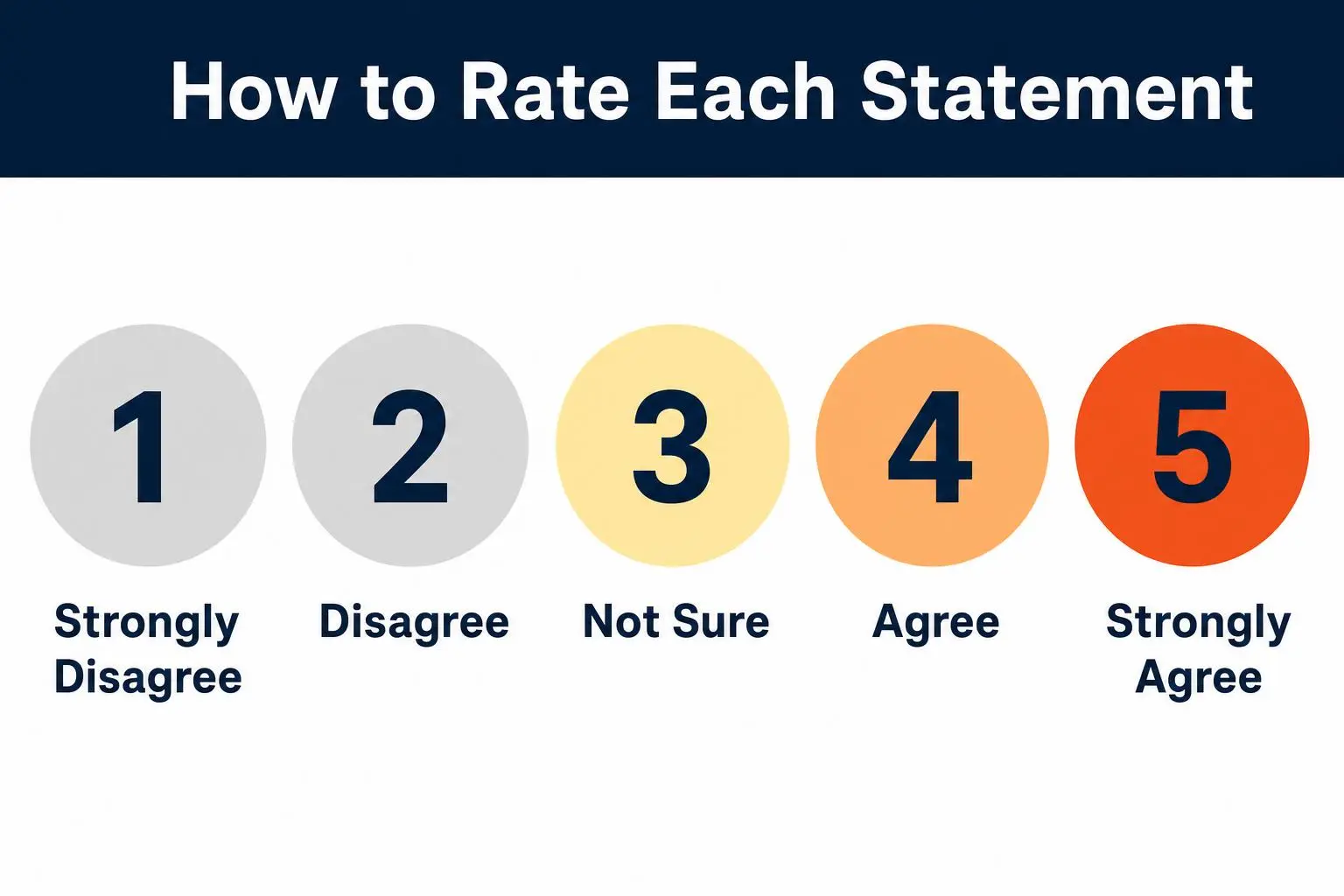
Parental Stress Scale – Self-Check
| # | Statement | 1 | 2 | 3 | 4 | 5 |
|---|---|---|---|---|---|---|
| 1 | I feel happy in my role as a parent. | 1 | 2 | 3 | 4 | 5 |
| 2 | There is little or nothing I would change about the way I am as a parent. | 1 | 2 | 3 | 4 | 5 |
| 3 | Caring for my child(ren) sometimes takes more time and energy than I have to give. | 1 | 2 | 3 | 4 | 5 |
| 4 | I sometimes worry whether I am doing enough for my child(ren). | 1 | 2 | 3 | 4 | 5 |
| 5 | I feel close to my child(ren). | 1 | 2 | 3 | 4 | 5 |
| 6 | I enjoy spending time with my child(ren). | 1 | 2 | 3 | 4 | 5 |
| 7 | My child(ren) cause more problems than I expected. | 1 | 2 | 3 | 4 | 5 |
| 8 | Having child(ren) has been a positive experience. | 1 | 2 | 3 | 4 | 5 |
| 9 | I feel overwhelmed by the responsibility of being a parent. | 1 | 2 | 3 | 4 | 5 |
| 10 | I feel trapped by my responsibilities as a parent. | 1 | 2 | 3 | 4 | 5 |
| 11 | I find my child(ren) enjoyable. | 1 | 2 | 3 | 4 | 5 |
| 12 | I am satisfied as a parent. | 1 | 2 | 3 | 4 | 5 |
| 13 | I feel that I cannot do things I like because of my child(ren). | 1 | 2 | 3 | 4 | 5 |
| 14 | Having child(ren) has meant having too few choices and too little control over my life. | 1 | 2 | 3 | 4 | 5 |
| 15 | I sometimes feel tired out from having to take care of my child(ren). | 1 | 2 | 3 | 4 | 5 |
| 16 | I often feel that my child(ren) are taking too much out of me. | 1 | 2 | 3 | 4 | 5 |
| 17 | I feel grateful for my child(ren). | 1 | 2 | 3 | 4 | 5 |
| 18 | I feel stressed by the things I have to do as a parent. | 1 | 2 | 3 | 4 | 5 |
Download the full printable version of the Parental Stress Scale here:
📥 Download Printable Parental Stress Scale (PDF)
You do not have to do any math. Just notice your gut reactions.
Quick way to read your answers
- If you circled a lot of 4s and 5s on the stress-heavy items (3, 4, 7, 9, 10, 13, 14, 15, 16, 18), your parenting stress is probably running high.
- If you circled higher numbers on the “connection and joy” items (1, 2, 5, 6, 8, 11, 12, 17), there are still parts of parenting that feel meaningful, even if you are stretched.
There is no perfect score. This is a snapshot of how you are doing right now, not a verdict on you as a parent.
If your answers scare you or leave you feeling alone, this is the kind of thing we unpack gently in session. You do not have to stare at those numbers by yourself.
Curious What Your Answers Mean?
At Phoenix Rebellion Therapy, we help parents in Salt Lake County and Davis County make sense of their stress and find a way forward.
Schedule an AppointmentWhat the Scale Is Really Asking
Behind the questions, the Parental Stress Scale is really asking about a few big themes.
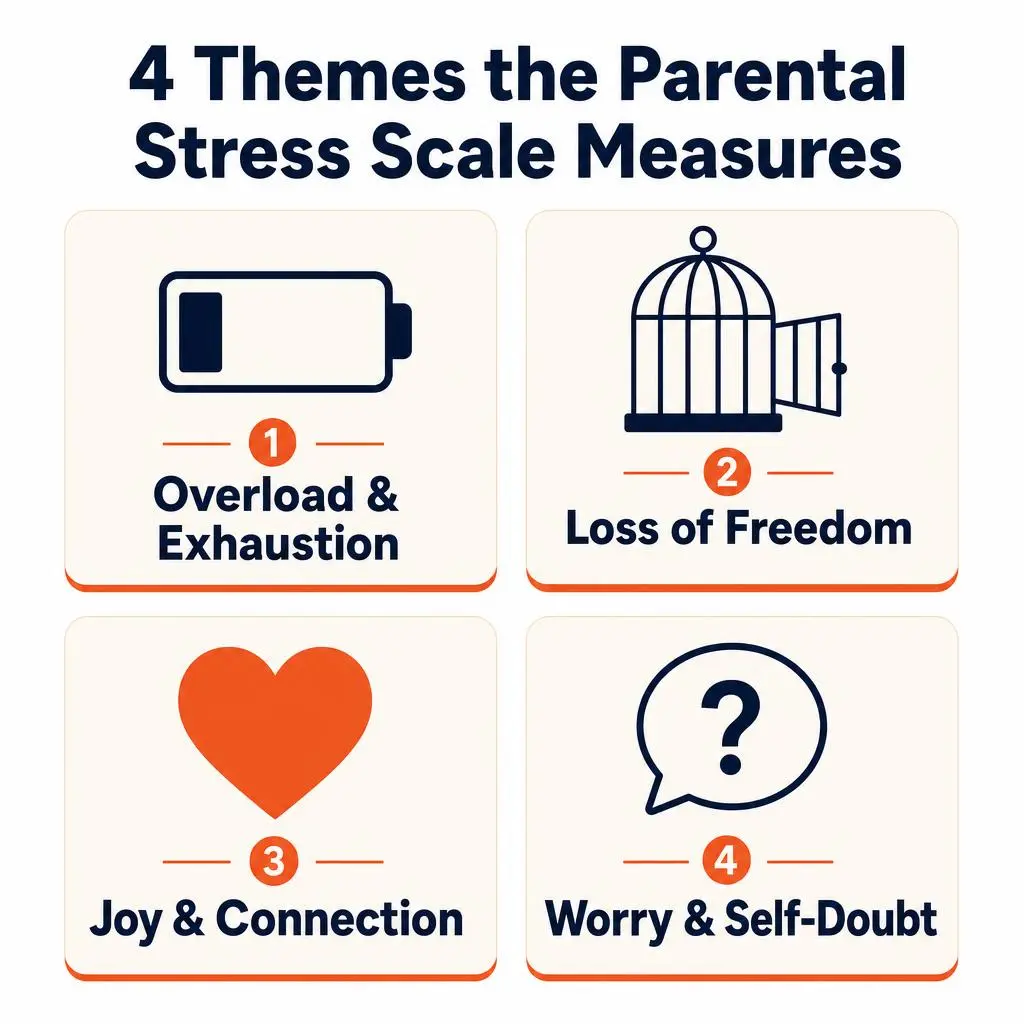
Overload and exhaustion
The “I am drowning” feelings:
- You never feel caught up.
- The mental list in your head never stops.
- You feel like you are always “on.”
Loss of freedom and control
The “I don’t get to have a life” feelings:
- You miss who you were before kids.
- You feel stuck in a routine you did not fully choose.
- You feel guilty any time you want time alone.
Joy and connection
The “my kids matter so much to me” feelings:
- You feel close to your child most of the time.
- You feel proud watching them grow.
- There are still moments that feel sweet or funny.
Worry and self-doubt
The “am I messing them up?” feelings:
- You worry a lot about their future.
- You doubt your choices and compare yourself to others.
When we go over your answers together, we are not just looking at totals. We are listening for which of these areas feel heaviest for you.
How We Use the Scale in Therapy
If we decide together to use the Parental Stress Scale, here is what it usually looks like:
- You fill it out honestly. There are no right or wrong answers.
- We go through it together and look at where your stress is highest and where you still feel some joy and connection.
- We use it to guide our work.
For example:
- If you are exhausted with no time for yourself, we focus on boundaries, schedule changes, and support.
- If worry and self-blame are loud, we work on your inner critic and your picture of a “good parent.”
- If you feel close to your kids but trapped and resentful, we work on balance and space for you as a person.
We may check back in later so you can see what is changing over time.
The scale is just a tool. The real healing comes from being able to say, “This is how it feels to be me right now,” and having someone really listen and help you make changes. Many parents also find it helpful alongside tools from cognitive behavioral therapy.
How to Start Lowering Your Parenting Stress
You do not need a questionnaire to know you want less stress. Here are some first steps many parents find helpful.
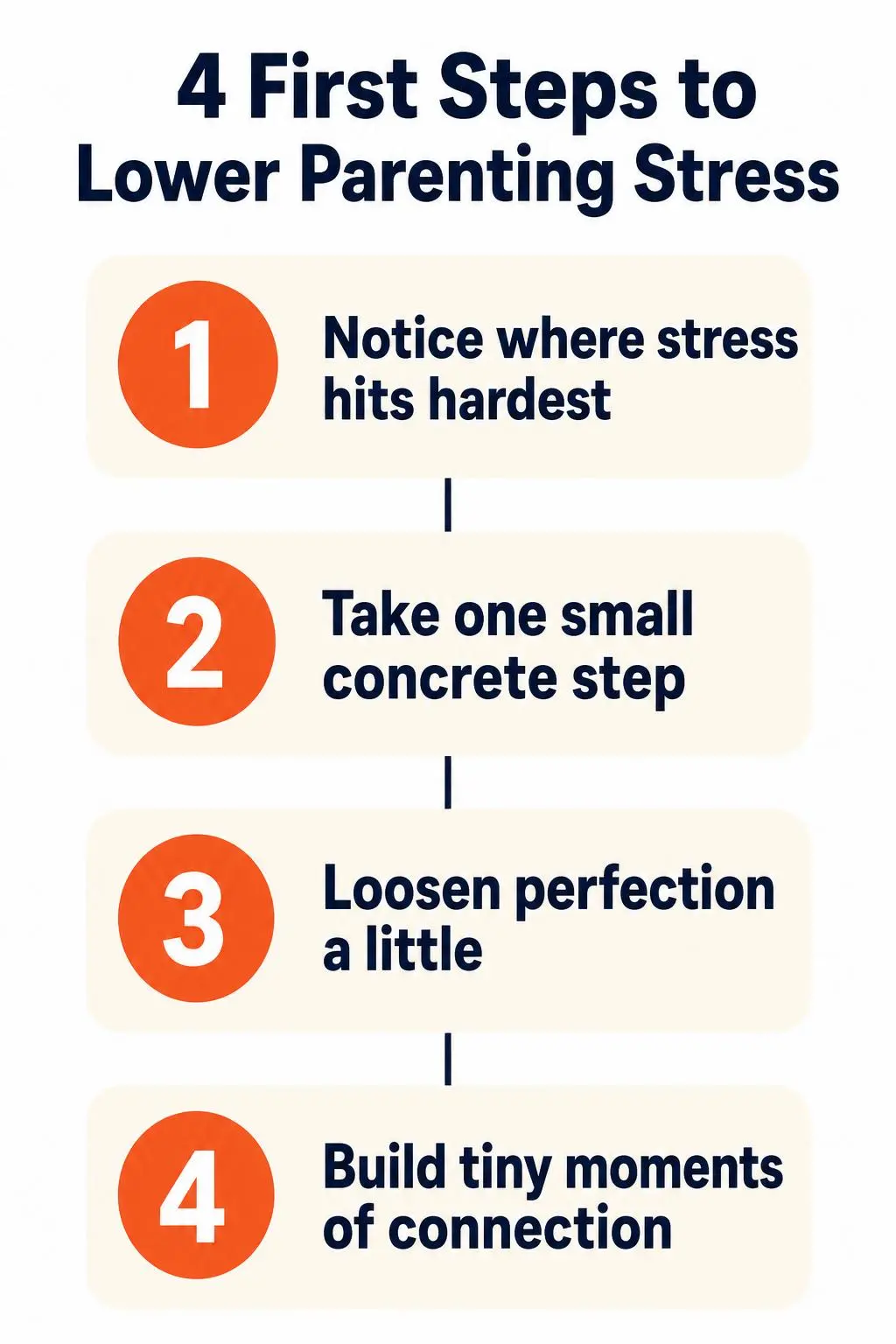
1. Notice where stress hits you hardest
Ask yourself:
- Is my stress more about time and never getting a break?
- Money and security?
- Behavior and conflict with my kids?
- Guilt and how I talk to myself?
Often there is one area that feels like the sharpest pain point. Naming it gives you a place to start. Patterns like this can also connect to hypovigilance or physical symptoms of PTSD.
2. Take one small, concrete step
Instead of trying to fix everything, pick one doable change.
3. Loosen perfection a little
Many parents carry unspoken rules like “A good parent always…” followed by a list no one can live up to. This can relate to enmeshment trauma.
4. Build tiny moments of connection
Stress is easier to carry when you also have small, real moments of connection with your kids.
When Your Stress Feels Like Too Much
If your stress has crossed over into thoughts of harming yourself or your child, or if your substance use feels out of control, you need more than a questionnaire. You need immediate support.
Please reach out right away if:
- You have thoughts of wanting to die or disappear.
- You are afraid you might hurt your child.
- You feel unsafe with how you are coping.
You Do Not Have to Do This Alone
If you are reading this and thinking, “This is me,” please hear this clearly:
You do not have to figure out on your own whether you are “too stressed,” “just stressed,” or already burning out. You only have to take the next step.
If you are ready for support, reach out. Your stress is real. So is the possibility of feeling more grounded, more supported, and more like the parent you want to be.
You and your kids deserve that. Many parents also find support by exploring balance in their relationship or attachment styles.
Ready to Lower the Pressure?
We offer in-person sessions at our Murray and Kaysville office locations, as well as virtual sessions over secure video conferencing from anywhere in Utah.
Schedule an Appointment